The Empire’s Oldest Trick
Dear Frontier Fortunes Subscriber,
In late-May, my wife and I were strolling the ancient streets of Bracara Augusta.
Here in modern times, Bracara Augusta is better known as Braga, Portugal, where I live—one of the oldest Roman cities on the Iberian Peninsula, founded by Augustus Caesar himself around 16 BC. For three days every year, Braga transforms into Bracara Augusta. Togas replace jeans. Vendors hawk replica coins and bronze jewelry. Legionnaires march through stone streets that have outlasted every empire that ever tried to own them.
As we passed vendor stalls and stopped for a plastic cup of wine, I was thinking about the Roman gold aureus coin that I own in a safe-deposit box back in the US. In theory, that coin could have passed through Bracara Augustus at some point—who knows?
Either way, that aureus and Braga’s homage to its past had me cogitating on Rome’s rise and fall… which—like it or not—serves as a cautionary tale for another empire: America today.
Every empire eventually discovers the same trick: When you can’t pay your bills, you cheapen your money.
Rome figured that out first. America exploited the knowledge millennia later.
That pure gold aureus of Augustus was eventually replaced by debased, shaved, adulterated coins—and that cheapened money marked the empire’s slow collapse…
The US has been running the same experiment in fast-forward since Nixon took us off the gold standard in 1971.
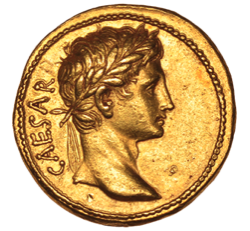
A Roman gold aureus depicting Caesar Augustus. Source: Wikipedia
Gold, of course, outlasted Rome and every other empire. And it’s going to outlast today’s highly devalued dollar. Gold did not care that Rome fell. It won’t care what happens to America and her greenbacks.
I’m reminded of all of this on a random Monday morning because a few hours before I sat down to write this issue of Frontier Fortunes, Donald Trump and Iran announced a peace deal, supposedly ending nearly four months of hostilities in the Middle East. The Strait of Hormuz—the 21-mile chokepoint through which roughly 20% of the world’s traded oil needs to pass every day—was set to reopen. Oil dropped 6%.
And gold?
It jumped nearly 3%, pushing back above $4,300 an ounce.
That’s noteworthy because of what would otherwise seem like an oddity: Gold spent the entire four months of war in decline. The oddity being that gold is a safe-haven asset that generally rises when geopolitics goes all dyspeptic.
And now that peace breaks out—gold surges.
It’s Bizarro World backwards… at least on the surface.
But buried inside that apparent contradiction is an important message about gold in this moment, and about why the last four months handed us a buying opportunity that the chaos conveniently disguised.
The reality is that gold behaved exactly as it should during the war: The dip in gold prices was due to governments selling some of their holdings to buy an asset that was rapidly rising in price—and which they couldn’t do without: oil.
“After four months of war, and the swings in the oil and gold markets, now is the perfect time to revisit and review our Energy and Metals Portfolio.”
With war on the back burner, gold and our gold plays will continue their march higher…
(Although, uncertainty remains. Will the deal hold? A few days after it was announced, Iran again declared it was closing the Strait. We shall watch closely.)
After four months of war, and the swings in the oil and gold markets, now is the perfect time to revisit and review our Energy and Metals Portfolio.
So, in this issue of Frontier Fortunes, I am going to do just that. (If you missed my recent review of where our crypto positions stand—you can catch that here.)
I’ll run through our entire Energy and Metals portfolio to give you an update on what’s been going on with each pick, what the future likely holds, and where I see opportunities today.
Let’s start with our two energy plays: Woodside Energy Group and Pembina Pipelines.
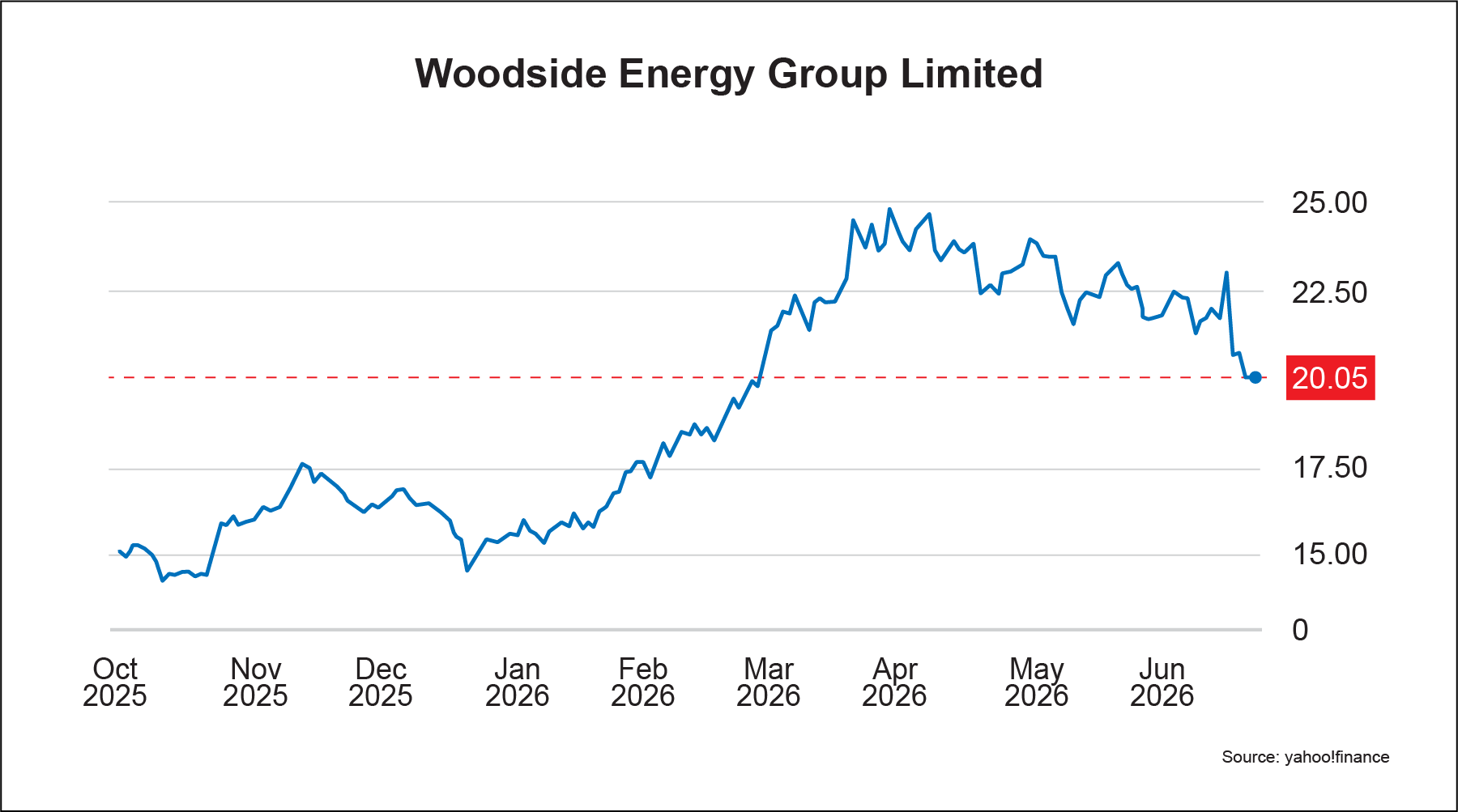
Woodside’s price has risen substantially since we entered the stock last fall—although it has bounced around.
When we went into WDS back in October of last year, the stock was in the doldrums, beaten down by weak pricing for liquified natural gas (LNG), a recent CEO departure, and investor skepticism about whether the company’s massive growth projects would deliver, particularly the LNG plant Woodside is building in southwestern Louisiana.
Since then, the shares have given us a volatile but ultimately rewarding run higher. We are now up about 50%, not including Woodside’s substantial dividend.
Driving the shares are three main factors:
Woodside reported record production for 2025, driven by outstanding performance from its existing asset base. That record output came with improved efficiency—a 4% reduction in unit production costs from 2024—which means more cash flowing to the bottom line.
This is a big one.
Scarborough is a massive, deep-water natural gas field sitting about 230 miles off the northwest coast of Western Australia. Woodside has been developing it for years and is now just weeks away from turning on production that will feed LNG into tankers headed primarily to Asia.
Total production capacity when fully operational will be 8 million tonnes of LNG per year—the single biggest jump in Woodside’s production capacity in a generation. When that first LNG cargo sets sail later this year, Woodside goes from a company running on its existing asset base to one with a major new revenue stream locked into long-term Asian supply contracts that will run for years.
This is new news—news that broke just this month and which I was not expecting when I recommended Woodside last year.
ExxonMobil is reportedly exploring acquisition opportunities, and Woodside is among the potential candidates.
Woodside management moved quickly to cool the speculation, clarifying it has no knowledge of any offer from ExxonMobil and is not participating in any talks. That is, of course, a standard boilerplate denial. But the fact that Exxon is reportedly doing internal due diligence on Woodside as a target is itself a significant signal about how the market values Woodside’s LNG asset base.
One question has been overhanging Woodside: the cost of the Louisiana LNG project mentioned above. The company acquired the project in 2024 by purchasing Tellurian for $900 million. The facility will consist of three liquefaction trains—essentially three parallel production lines that chill natural gas into a liquid for loading onto seaborne tankers—with a combined capacity of 16.5 million tonnes of LNG per year. Expansion permits are already in place for two additional trains that would push total capacity to 27.6 million tonnes, making Woodside’s one of the largest LNG export facilities in the world.
Total project cost for the first phase is $17.5 billion, which investors saw as a very heavy lift even for a company Woodside’s size.
To address it, Woodside has decided not to carry it alone.
Management sold a 40% equity stake to private equity firm Stonepeak for $5.7 billion, with Stonepeak covering 75% of construction costs. It also brought in Williams, one of America’s premier gas infrastructure companies, as an 80% partner on the project’s pipeline.
Those two moves reduced Woodside’s own capital commitment, while allowing it to keep operational control of the facility itself. Production is on track and about three years away, and when Louisiana LNG is fully running alongside Scarborough and the existing Australian asset base, Woodside will control more than 5% of global LNG supply.
That’s the long game we’re playing, and it’s playing out well.
We’re approaching our payoff moment.
Again, we’ve done well with Pembina, and we’ve collected about $7.30 worth of dividends so far, or about 23% of our original cost basis in this stock. Not bad.
Two big moves have defined the Pembina story since my original recommendation.
Back in April 2024, Pembina closed a $3.1 billion acquisition that gave it full control of the Alliance Pipeline and Aux Sable. This was transformational. Alliance is a major natural gas transmission pipeline running from western Canada to Chicago, and Aux Sable is a large, natural gas liquids (NGL) extraction facility at the end of the pipeline.
So Pembina now has full, direct control over an end-to-end system moving Canadian gas to US markets, leading to meaningfully boosted earnings.
Cedar LNG is a $4 billion project with a capacity of 3.3 million tonnes per year; Pembina owns 49.9%. This is Pembina’s ticket to the global LNG market: Canadian natural gas liquefied on the British Columbia coast and shipped to Asia. Commercial operations are anticipated in late 2028.
Pembina has already signed a 20-year agreement for 1 million tonnes of LNG per year to PETRONAS, Malaysia’s energy giant… and a 12-year agreement with Ovintiv for 0.5 million tonnes per year. Essentially, both PETRONAS and Ovintiv are producing nat-gas in Canada, and then shipping that gas through Pembina pipelines to Cedar LNG.
Pembina management raised full-year earnings guidance, primarily reflecting stronger commodity prices. And management recently raised the dividend to $0.735 per share, a 3.5% increase.
So Pembina is playing out just as expected. It is running nat-gas to Canada’s West Coast for liquefaction—one of the original reasons we went into this stock—and we’re getting paid more to hold the shares.
Much winning!
Pembina is near record highs. If you got in on my recommendation, you’re sitting pretty. If you didn’t get in… I wouldn’t buy here. I’d be looking to add Woodside at lower prices, as I explained above, or I would be buying gold stocks as I explain below.
And with that, let’s jump into the metals side of the portfolio…
A quick overview that applies to all the gold positions: The gold market, as I noted at the outset, felt the impacts of the war with Iran. Gold prices fell, dragging down the price for gold-mining stocks, even though nothing bad happened to gold-mining operations.
If anything, the gold price selloff has given us an opportunity to add to our gold positions, or to initiate positions if you didn’t buy the first time around.
We sold half of our position in Metalla back in December, locking in a 122% gain in just six months.
With the other half we still own, we’re currently up more than 108% as I write this, and at one point were up more than 163% before the war’s impact on gold prices.
As I mentioned above, the pullback has nothing to do with the business—it has improved throughout the war.
When I recommended Metalla in the summer of 2025, it was a royalty company with significant promise, and the promise has come through.
(As a reminder: A royalties/streaming business is a company that invests in other mining projects and simply collects royalty income from the metals produced and sold.)
Metalla reported record 2025 financial results with revenue doubling to $11.7 million. That momentum continued into Q1 of this year, when the company delivered royalty revenue of $3.1 million, up 78% year-over-year, with net income of $0.1 million versus a prior-year loss.
That net income figure is meaningful. It was Metalla’s first profitable quarter, a milestone that changes how institutional investors look at the stock. As I routinely point out, I am a big fan of owning small gold companies approaching their first mining operations—or in the case of Metalla, their first profitable quarters. That’s almost always a great time to be an investor.
Several of Metalla’s royalties have been moving in important directions:
Côté & Gosselin is the crown jewel in the portfolio and in November last year, Metalla acquired an additional 0.15% interest in the Côté-Gosselin NSR (“Net Smelter Return”) royalty, bringing its total to 1.5%. In terms of validation, Franco-Nevada, one of the world’s biggest gold royalty companies, put more than $1 billion into the same mine, meaning one of the big dogs bought exposure to the same asset Metalla already holds. That’s a robust third-party endorsement.
IAMGOLD, the mine’s owner, plans to release an updated technical report later this year outlining a larger-scale Côté mine. That report is a potential catalyst—exactly what we want to look for: royalty companies that own exposure to mines that are expanding.
A larger mine leads to a larger royalty stream, leading to a larger share of gold, larger profits, and a fatter share price.
The royalty machine that is Metalla continues to compound. The structural and long-term gold price tailwind—now reasserting itself post-Iran war—amplifies every royalty payment across the entire portfolio simultaneously, without adding a dollar of operating cost to Metalla’s books.
That’s the beauty of the royalty model.
We’re up about 107% in the year that we’ve owned McEwen.
And, once again, this has been the story of a small miner that moved into profitability.
When I recommended MUX, the company was still posting losses. That changed dramatically when McEwen reported net income of $33.4 million for Q1 2026, a strong turnaround from a $6.3 million loss a year earlier.
McEwen runs four producing assets: Gold Bar in Nevada, the Fox Complex in Ontario, Canada, the San José mine in Argentina, and the Fenix project in Mexico.
The company maintained its 2026 production guidance at 114,000 to 126,000 so-called gold equivalent ounces (known as GEOs) after delivering 30,471 GEOs in Q1, signaling output growth is on track.
Through late May, McEwen had received $58.2 million in profit distributions flowing from its stake in the San José mine—well ahead of the $40 million to $50 million it had originally expected for the full year.
At the Fox Complex, growth is accelerating. In 2026, production is expected to contribute between 75,000 to 90,000 GEOs annually toward the company’s consolidated target of 250,000 to 300,000 GEOs by 2030.
Meanwhile, the Grey Fox part of the Fox Complex just received a major update: a pre-feasibility study released this month that outlined high returns, manageable capital, and a mine life extended to 2041. That’s a significant de-risking event meaning that Grey Fox goes from a resource on paper to a project with a defined economic blueprint. And it holds 1.9 million indicated ounces at an average grade of 3.02 grams of gold per tonne of ore—a high-grade prospect.
I mentioned this in the original recommendation. Along with being a play on gold, McEwen is also a play on copper, a metal that I have been excited about because of explosive demand in the green-energy re-electrification trend blanketing the planet.
Los Azules is a massive copper project in the Argentine Andes, held through McEwen’s subsidiary McEwen Copper. The project has a projected 22-year mine life with potential to extend to 33 years, and it’s expected to produce 205,000 tonnes of copper annually in its first five years, averaging 148,000 tonnes thereafter. To put that in context, that’s roughly 1% of current global copper production from a single project—significant by any measure.
The near-term catalyst to watch: McEwen Copper is progressing toward an IPO later this year. When McEwen Copper lists independently, it will crystallize the value of McEwen Inc.’s 46.3% stake in Los Azules—value that currently sits largely invisible inside the parent company’s share price. That IPO is potentially the single biggest re-rating event for MUX shareholders over the next 12 months.
Wall Street analysts are now jumping on board, with some talking about a $35 valuation, which would mark a double in price from here.
We sold half our position for a 112% gain back in December, after holding it for six months. And we’re going to see very nice gains continue going forward.
First, Orla is no longer Orla—or soon won’t be.
Orla and Equinox Mining recently agreed to a merger, in which Orla will fold into Equinox at a 1:1 basis and will take on the Equinox name. That deal is expected to close in Q3.
As for the business, when I originally recommended Orla back in July 2023, it was essentially a one-mine company—the Camino Rojo mine in Zacatecas, Mexico, producing around 100,000 ounces of gold per year.
Over the three years since, the company transformed itself dramatically.
The biggest single event: Orla acquired the Musselwhite Mine in Ontario from mining giant Newmont in late 2024. Musselwhite is an underground gold mine with a long history of resource growth. In 2025 it produced 203,856 ounces of gold. Combined with Camino Rojo, that pushed Orla’s total 2025 production to 300,620 ounces—essentially tripling its output from when we first went into this position.
Revenue in 2025 hit $1.06 billion, up 207% from $344 million the prior year.
Camino Rojo, meanwhile, has continued delivering and expanding. Orla has identified a new prospect that exists directly beneath the existing mine. The mine is defined as having high-grade ore holding an additional 1.45 million ounces of gold, representing the next decade of production from Camino Rojo.
The combined Equinox-Orla entity will produce approximately 1.1 million ounces of gold annually, creating the second-largest gold producer in Canada behind Agnico Eagle.
The deal structure means that existing Equinox shareholders will own approximately 67% of the combined company, while former Orla shareholders will own approximately 33%. So, we’re not being cashed out, so much as we’re rolling into a much larger, more diversified senior gold producer.
At 1 million ounces per year, Equinox with Orla inside is officially a major miner. Again, this goes to something I’ve routinely talked about in my mining coverage: Owning mid-tier miners, as well as junior miners already in production, almost always ends with you owning a major miner.
Either two mid-tiers marry to form a major miner, or a major miner snaps up the smaller player.
It’s just the way the game is played.
The deal has strong insider support. Legendary mining investor Pierre Lassonde and Prem Watsa’s Fairfax Financial Holdings, who collectively control approximately 20% of Orla’s shares, both favor the transaction. And when Pierre Lassonde—one of the most respected names in gold investing—signs on, well, that’s a signal.
Though there is no buyout premium for Orla shareholders, with gold above $4,000 per ounce, the combined company trades at a discount to peers. And the growth pipeline—potentially 1.9 million ounces annually over time—creates substantial upside for all shareholders. So, Orla shareholders aren’t getting sold out; they’re getting merged up into a larger vehicle at a moment when scale matters in the gold sector.
We sold half our position in Orla last summer for a 173% gain.
The other half will become Equinox in a few months.
This is another stock with which we sold half of our original position. We locked in a 191% gain last December after holding it for about two-and-a-half years.
Silvercorp is a Canadian miner of silver, gold, lead, and zinc—almost all of that mined in China.
The China concentration is Silvercorp’s greatest strength and its most talked-about risk.
The strength: Silvercorp’s silver all-in sustaining cost (a key metric in the mining industry) is $9.70 per ounce versus an estimated global average of $12.20—making it one of the lowest-cost silver producers on the planet. With silver trading in the range of $70, the company’s margins are extraordinary.
The worry: Every ounce of production currently comes from China, which means regulatory risk, currency risk, and geopolitical risk all live inside this stock. The US-China relationship has been the defining macro tension of this era, so there is a discount investors apply to the stock that they don’t apply to other silver miners.
But so be it…
Just this month, Silvercorp dropped a significant piece of news. A new technical report on the Ying Mining District shows an approximately 106-million-ounce increase in silver that will be mined over what is currently the remaining 17-year mine life. That’s a meaningful extension of the asset’s productive life—driven partly by higher silver price assumptions.
That unlocks value which was previously not economically feasible.
When I first recommended SVM in 2023, it was essentially a China-only story. That’s no longer true. The company has been aggressively diversifying…
Kyrgyzstan: Silvercorp completed a $92 million acquisition of Chaarat ZAAV in Kyrgyzstan, adding the Tulkubash and Kyzyltash gold projects. In May 2026, Silvercorp secured a 30-year license extension and joint venture structure for those Kyrgyz gold projects—giving the assets long-term regulatory certainty in a jurisdiction that had previously been uncertain.
Ecuador: Silvercorp holds a stake in the El Domo copper-gold project in Ecuador through its investment in New Infini. This is a development-stage asset that adds copper exposure to what was previously a pure silver story.
Ying expansion: A new mill is under construction at Ying to increase throughput capacity, funded by the company’s substantial cash balance.
This is the development that could most significantly re-rate SVM in the short to medium term.
Back in May, Silvercorp filed a listing application with the Hong Kong Stock Exchange for a triple primary listing and global share offering. This means SVM would trade simultaneously on the Toronto, New York, and Hong Kong stock exchanges.
That matters because while Silvercorp’s mines are in China, its investors are almost entirely Western. A Hong Kong listing opens the stock to Chinese and Asian institutional investors who understand Chinese mining operations far better than Western markets do—and who might value them more generously.
As such, that Hong Kong listing, assuming it finalizes in Silvercorp’s favor (seems likely) could be a nice re-rating event that Wall Street analysts have not yet really priced in.
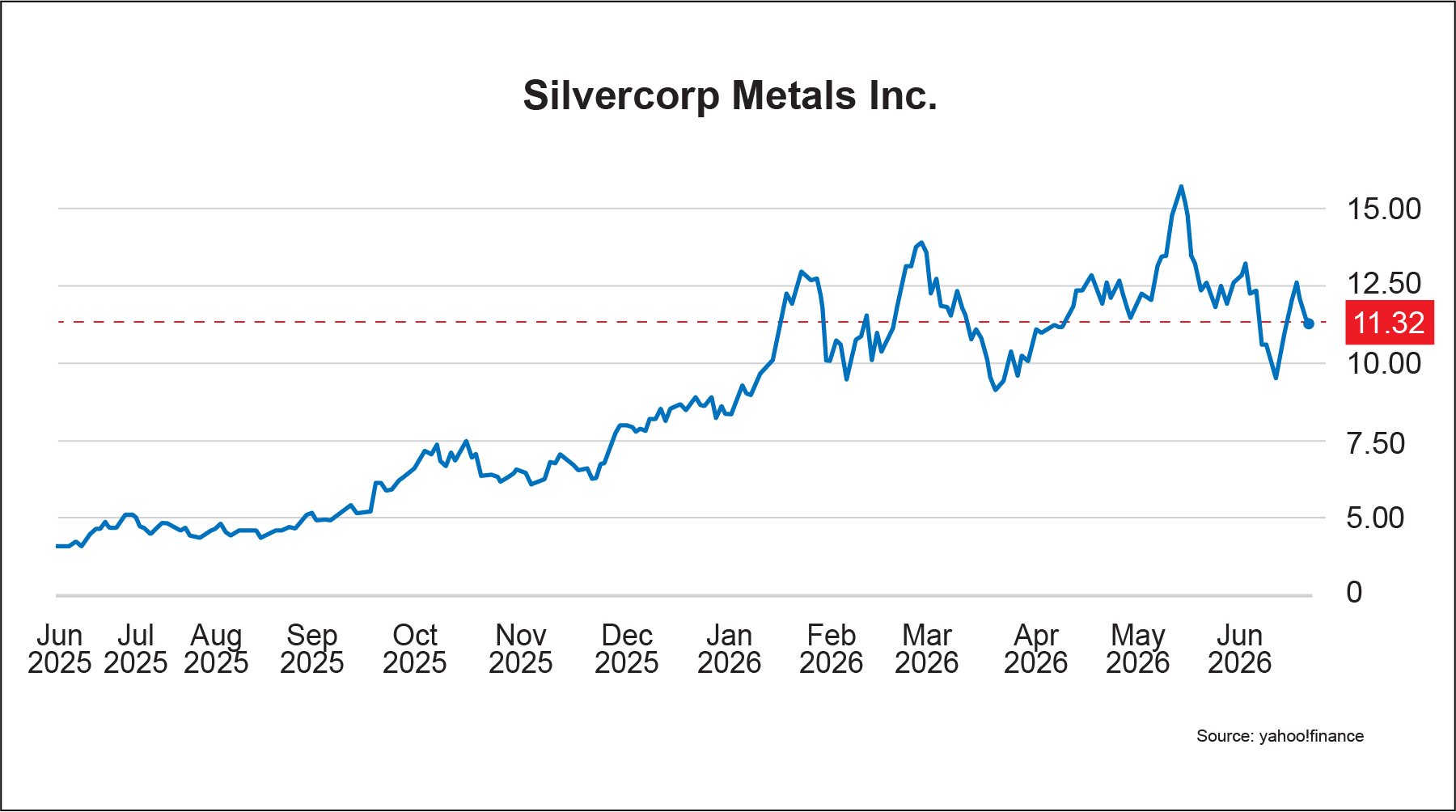
Silvercorp has been volatile—but you can see the clear trend upward since we added it to our portfolio.
These shares are very bouncy as they march higher. In the last year, the stock is up nearly 200%, but there have been three instances this year alone where the shares fell between 25% and 37%, only to rebound to higher highs.
And finally…
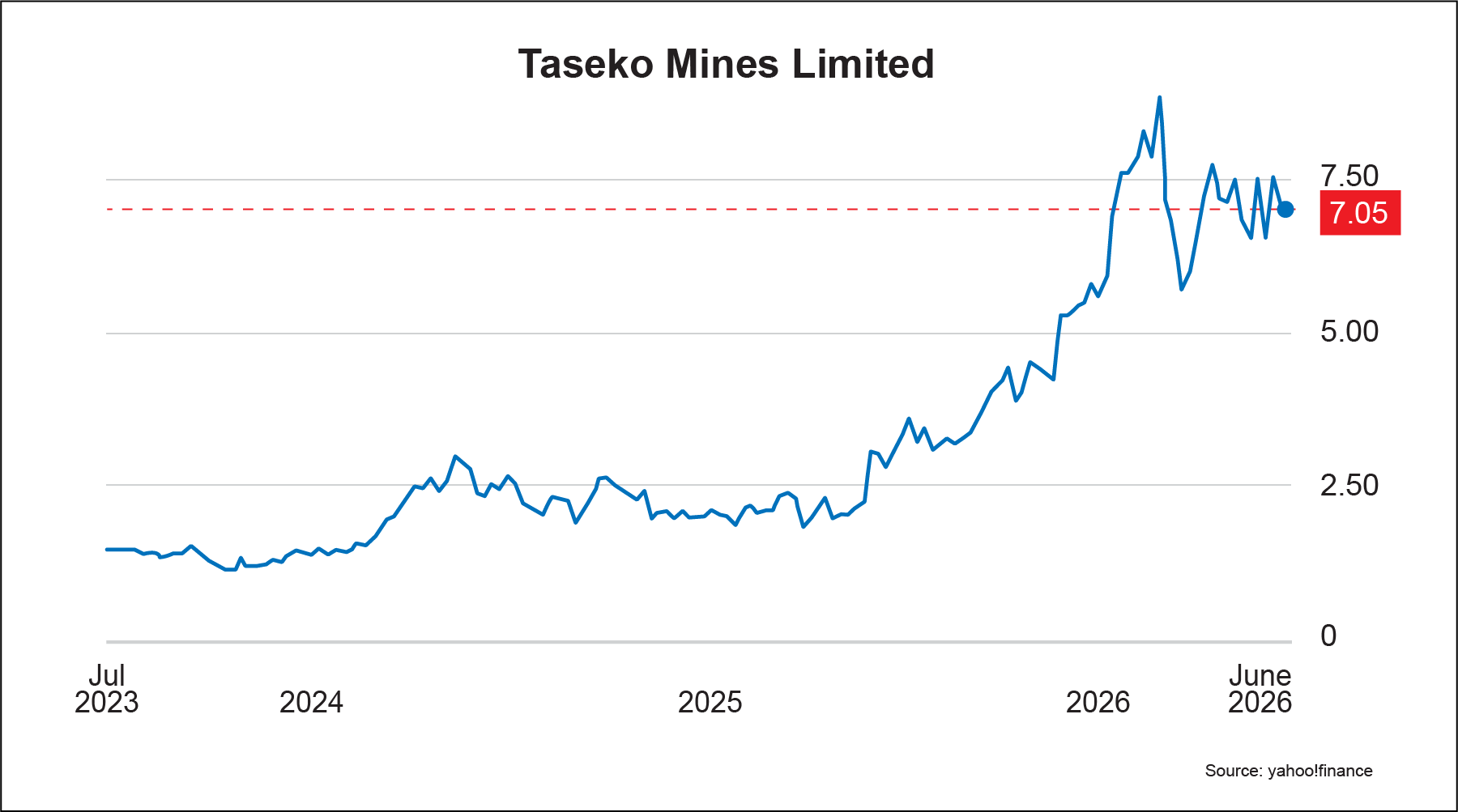
Taseko has climbed about 400% in the time we’ve owned it.
“Taseko has followed almost perfectly our original thesis from 2023: Rising demand from copper because of the re-electrification of the planet, running headlong into a supply crunch.”
Taseko has followed almost perfectly our original thesis from 2023: Rising demand from copper because of the re-electrification of the planet, running headlong into a supply crunch.
Taseko is a pure-play North American copper producer, with one mine in British Columbia, Canada, and the other in Florence, Arizona.
When I first recommended Taseko, Florence was still in development. Today it’s producing copper. That has been transformative for the company.
The Florence Copper plant began operations earlier this year when it began producing its first copper cathodes—finished, pure copper sheets ready for industrial use.
Taseko is targeting as much as 35 million pounds of copper cathode production at Florence by the end of the year. That’s on top of Gibraltar’s 110 million to 115 million pounds—taking Taseko’s total annual copper production from roughly 100 million pounds to potentially 150 million pounds in a single year.
Taseko is leveraged to copper, and copper’s story has only gotten stronger since the 2023 recommendation.
The average copper price in Q1 2026 was 16% higher than the previous quarter. The structural drivers—AI data center buildout, electrification, EV adoption, grid upgrades—haven’t changed. If anything they’ve accelerated. Taseko is essentially a leveraged bet on the proposition that the world needs more copper and can’t get it fast enough from existing sources.
That’s the core of our thesis—and it remains fully intact.
The catalysts from here are straightforward: Florence Copper continues its production ramp through 2026, and Gibraltar sustains its improved production profile. And copper prices remain elevated on structural demand.
As with most of our other positions, we’ve already sold half of Taseko to recoup our original investment and pocket some profits. We sold half of Taseko last summer for a 103% gain. Now, we’re up over 300%—and recently as much as 400%—on the remaining half. It’s hard to tell you to be a buyer of Taseko if you don’t already own it.
“I expect we’re going to continue to see our stocks march higher.”
So that’s where we stand with all of our Energy and Metals positions.
We’re in good position all around.
The trends we care about remain fully in place, and I expect we’re going to continue to see our stocks march higher.
Talk to you next quarter…
Jeff D. Opdyke
Editor, Frontier Fortunes
© Copyright 2026. All rights reserved. No part of this report may be reproduced by any means without the express written consent of the publisher. This report presents information and research believed to be reliable, but its accuracy cannot be guaranteed. There may be dangers associated with international travel and investment, and readers should investigate any opportunity fully before committing to it. Nothing in this e-newsletter should be considered personalized advice, and no communication by our employees to you should be deemed personalized financial or investment advice, or personalized advice of any kind. We allow the editors of our publications to recommend securities that they own themselves. However, our policy prohibits editors from exiting a personal trade while the recommendation to subscribers is open. In no circumstance may an editor sell a security before our subscribers have a fair opportunity to exit. The length of time an editor must wait after subscribers have been advised to exit a play depends on the type of publication. All other employees and agents must wait 24 hours after on-line publication prior to following an initial recommendation. Any investments recommended in this letter should be made only after consulting with your investment adviser and only after reviewing the prospectus or financial statements of the company.