Make Big Gains From the World’s Growing Thirst for Energy
Dear Frontier Fortunes Subscriber,
A frail woman pulled back a limp, burlap rice sack serving as her front door. I entered.
Her hut was tiny—maybe 6 or 7 feet wide by about 8 feet long. I had to hunch my 6’2” frame, lest I bump my head against the corrugated-tin roof, caked in black soot from the open flame of burning wood and coal that served as her stove.
Darkness ruled, threatened only by thin beams sneaking in beneath gaps in the corrugated roof, and the diffuse light piercing the burlap.
I’d come to Bhubaneswar, on India’s often monsoonal northeast coast, specifically to find this particular, frail woman. She was the slum-dwelling mom to a little girl with an amazing backstory. This mom had sold the little girl into servitude at seven years old. The girl had persevered and ultimately qualified for a spot on the Indian national soccer team for girls under the age of 14. I was interviewing the mom to understand her story as part of a screenplay I wrote. (I optioned the script a few years ago, so maybe you’ll see it on the big screen one day…)
But those last four paragraphs aren’t really about the mom or the little girl, per se. They’re an apropos setup for a much larger story for this issue of Frontier Fortunes.
See, I have traveled across a fairly large swath of the world—nearly 80 counties now, spanning the six habitable continents. I’ve seen regal homes in London, Singapore, Shanghai, and Argentina. I’ve seen modest homes in the Czech Republic, Greece, Morocco, Thailand, and Estonia.
And I have seen hovels like the one in Bhubaneswar…
The difference, of course, is access to opportunity.
Half the world’s population lacks the energy required to address basic human needs. Thus, the soot-filled hut I spent an hour in, talking with an astonishingly impoverished mom.
Her plight speaks to what researchers call “energy poverty,” the definition of which I am sure you reflexively understand just by the context.
So far this millennium, more than a billion people have moved out of energy poverty and have gained access to enough electricity to power the basic appliances of life, particularly for cooking.
Still, billions of people live daily lives with limited or no access to electricity. You won’t be surprised to know that the problem primarily afflicts Sub-Saharan Africa, and South and Southeast Asia. But you might be surprised to learn that more than 70 million Americans live in energy poverty, primarily across Appalachia and the South. And that nearly 50 million Europeans struggle without basic access to electricity, or with limited access. Mainly, that’s a problem along the old Soviet border, from Latvia down through Bulgaria. But even where I live in Portugal (and in neighboring Spain) the problem exists.
So it is, then, that this issue of Frontier Fortunes focuses on energy.
Not so much on electricity providers, but on a company and a fuel type the world increasingly demands as it seeks to generate ever-more power to bring the darkened into the light.
And no… this has nothing to do with uranium and nuclear power.
We’re going much more basic than that.
We’re going into the natural gas fields of south Louisiana and Western Australia.
Fifteen or so years back, I was living and working in south Louisiana for what was then known as The Sovereign Society, at one time a sister publication to International Living. At the time, America was the #2 producer of natural gas, trailing only Russia.
However, the US was a near-silent hiccup when it came to LNG, or liquified natural gas. In 2011, the timeframe I’m talking about, America ranked 17th in terms of LNG production, according to the International Gas Union’s “World LNG Report 2011.”
But 17th isn’t what it seems.
The US that year produced 0.3 million tonnes of LNG.
Number 16 on the list—Norway—produced 2.9 million tonnes, nearly 10x America’s volume.
Atop the list: Qatar, an LNG behemoth squeezing from its Arabian sands nearly 76 million tonnes, massively dwarfing US efforts.
But there along south Louisiana’s Gulf Coast, a then-small company called Cheniere Energy was building America’s first true LNG plant. Cheniere management saw that A) America was awash in natural gas because of the success of the shale boom and the innovation of horizontal drilling; and B) rising demand for LNG among fast-growing countries with limited or no access to natural gas and oil reserves.
At the time, no one much cared about natural gas. Because of the aforementioned gas boom and horizontal drilling, nat-gas supplies in the US multiplied like randy rabbits—growing to nearly 400 trillion cubic feet from less than 200 trillion just a few years earlier.
As such, natural gas prices had collapsed… on their way to about $2 per million cubic feet of nat-gas in 2012 from roughly $13 for the same quantity in 2008.
I told my readers back then that the US was on the verge of becoming a nat-gas supergiant—that the country would one day be the Saudia Arabia of natural gas. And that to benefit, they should own shares in Cheniere Energy, trading at that time in the $7 range. I called Cheniere the “first mover in LNG export” and expected it would see much higher highs.
When the overall stock market had a big sell off in September of that year, I urged readers to double down on Cheniere at prices under $5.
Today…
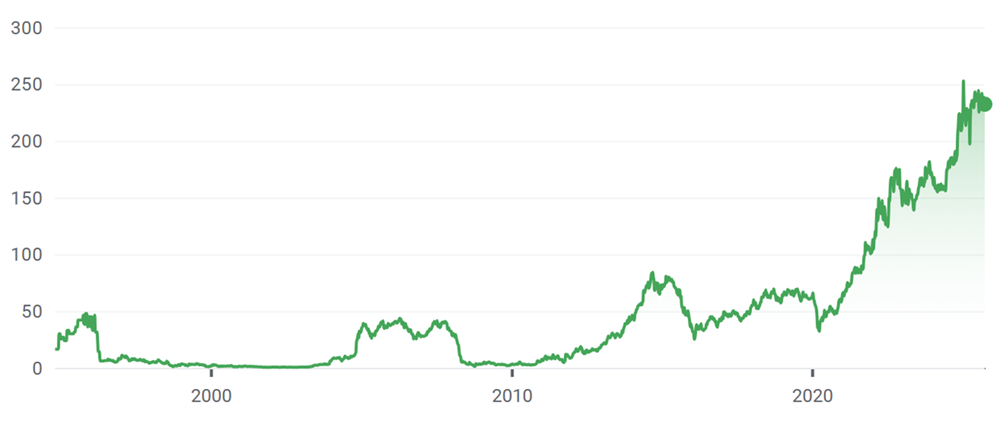
Cheniere has skyrocketed since I recommended it in 2011. Source: Google Stocks
Cheniere is America’s preeminent and predominant producer of LNG, cranking out nearly 50 million tonnes of LNG annually from two facilities—Sabine Pass, Louisiana, and Corpus Christi, Texas. Sabine Pass is now one of the largest LNG platforms in the world.
As for Cheniere’s stock price… as I write this, it’s flirting with all-time highs of nearly $240—a 35x return over 14 years. A $10,000 investment back in the summer of 2011 is $350,000 today.
I share all of that not to relive any past glory, but to underscore the opportunity I see shaping up in what I will call “a mini Cheniere.”
And I’ve had my eye on it for a while—watching the price for the best moment to buy…
In your last quarterly issue of Frontier Fortunes, I wrote that I would soon be sending you a new energy play for our Energy and Metals Portfolio. I was waiting because I felt we would see a further fall in oil prices, and I wrote that I had my eye on one oil stock “I particularly like, and which has strong ties to the liquified natural gas industry.”
I felt the price would fall further and create an opportune buying moment… which has now arrived.
The company: Woodside Energy Group.
Woodside is old-school energy. The company launched in 1954, just as Australia’s energy-exploration era began to boom. By the 1970s, Woodside was on the path to becoming an Aussie energy heavyweight changing the dynamics of the local energy market. In partnership with global giant Shell, Woodside began developing the North West Shelf Venture, what would emerge as one of the world’s largest liquified natural gas projects.
That field has been producing nat-gas since the 1980s and has been a significant LNG producer since then.
As such, Woodside pioneered Australia’s LNG industry decades before LNG would become one the planet’s most crucial sources of energy.
Today, nearly 60 countries import LNG to meet energy needs in their local economies. Some of those are the big economies you would suspect, such as China, India, Japan, and Germany. Others are much smaller countries with fast-growing economies but limited access to local energy resources, such as the Dominican Republic, Greece, Thailand, Bangladesh, and numerous others.
Over the last 25 years, LNG demand has tripled globally, marking annual demand growth of about 4.5%. BP Energy Outlook, an annual estimation of global energy trends from UK energy giant BP, forecasts LNG demand will effectively double from here through 2035.
Several fundamental trends are driving the growth. These are what I consider the top five:
Those trends will require about 100 million metric tons of additional LNG supplies as we move into the 2030s.
The US will be a big player in providing those additional supplies, given America’s vast quantity of natural gas reserves and its technological advantages in drilling and fracking. Already, the US is responsible for sating about a quarter of the world’s thirst for LNG. That will remain steady, if not grow slightly.
Australia, meanwhile, is the world’s #3 supplier of LNG, and is a particularly robust player in the insatiable Asian market. China, after all, effectively uses Australia as its neighborhood hypermarket, snapping up all kinds of commodities and prepared foods and beverages.
Now, I specifically note the US and Australia because those two countries, it turns out, are where Woodside is now in the process of expanding its LNG business.
Meaning that with Woodside, we’re tapping into the world’s expanding demand for LNG by snapping up shares of a company that is on the road to becoming a critical cog in the LNG space in both countries.
Though Woodside is already a leading player in LNG in Australia, it is strategically expanding its Aussie operations while also expanding into the US with a new LNG plant about an hour from Cheniere’s Sabine Pass facility, the largest LNG plant in America.
Woodside’s Louisiana facility received final approval last April, and once complete in 2029, it will produce just under 28 million tons of LNG annually. Cheniere’s Sabine Pass produces about 30 million tons.
That’s one of the reasons I refer to Woodside as a mini-Cheniere—it’s on path to basically produce what Cheniere produces, and just at a moment when demand for LNG is soaring.
Now I’m going to bet that “once complete in 2029” has you thinking, “Well, that’s four years away. Why do I want to own Woodside now?”
Again, we have several reasons that, I believe, will propel Woodside’s share price before the Louisiana LNG facility is up and running.
This is Woodside’s new Australian LNG plant and it’s nearly 90% complete. It’s on track to begin sending out its first LNG cargos in the second half of next year, which will add about 5 million tons of annual capacity to Woodside’s LNG business.
The plant is built largely to serve the explosive demand across neighboring Asia. That said, the project recently signed a long-term deal to supply 5.8 billion cubic meters of LNG to Turkey's BOTAS Petroleum Pipeline Corporation starting in 2027, ensuring stable cash flows and reducing market risk.
Overall, Scarborough by itself could drive a 10-15% production uplift by 2027. We’re already approaching 2026, and the market looks forward to what’s coming, so we could begin to see Woodside’s price push higher as 2026 unfolds and expectations regarding Scarborough begin to play through the shares.
This is a deepwater oil and gas well Woodside is developing in the Gulf of Mexico with Mexican state energy giant PEMEX. Woodside owns 60% of the project.
Woodside expects Trion to come online in 2028. At peak production of 100,000 to 120,000 barrels of oil equivalent per day, Woodside would be looking at $1 billion to about $1.5 billion per year in additional revenue, based on where oil prices are at the time (those estimates are based on oil in the $45 to $70 per barrel.
As those two stories play out, the world’s ongoing demand for LNG keeps growing, and Woodside will continue to be a player in that, meaning production volume will ramp up from about 190 million barrels of oil equivalent this year to roughly 207 million barrels by 2029.
So we have continual production growth to anticipate… though market prices for oil, natural gas, and LNG will obviously play a role. There, however, we’re buying at a moment when oil prices are already depressed. Natural gas prices on the global market are also down sharply from the months just after Russia invaded Ukraine, but they’re not depressed.
Still, demand is consistently growing and oil and nat-gas prices are at levels that mean we’re buying Woodside at an opportune moment.
All in, I see Woodside shaping up as a top-tier global LNG giant over the remainder of this decade.
The Aussie LNG plant allows Woodside to sell greater quantities of LNG into Asia and Africa, while the Louisiana plant will give Woodside enhanced exposure to Europe. Given the increasing production of natural gas in the US, and given the increasing global demand for US natural gas, Woodside’s Louisiana facility is sure to capture a significant portion of America’s growing LNG exports.
Overall, Woodside in on target to boost its production by more than 30% by the time the 2030s arrive.
And we’re going to tap into it now so that we can ride the LNG wave alongside the company.
Woodside trades at $15.35 as I write this, so there is plenty of headroom to get into this position.
The shares trade as American depositary receipts on the New York Stock Exchange, so you won’t have a problem buying them through any US brokerage firm, including the app-based firms such as Robinhood and Webull.
I give the shares a “higher risk” rating because, well, this is the energy sector, and energy stocks tend to be volatile. That said, I would argue that Woodside’s shares have been de-risked in the energy sell-off that has happened this year.
The shares were trading north of $26 back in 2023, and today, as I noted, they’re in the $15.35 range. In the last five years, they’ve been as low as $11.63. So theoretically, there’s some potential downside to the low-teens. But $15-ish seems to be a zone of support with multiple examples over the years of the shares bouncing off the $15 zone.
So I feel comfortable recommending Woodside at these prices.
We’re also going to be picking up a very nice dividend yield.
As with most companies in Asia and Oceania, Woodside pays dividends every six months, rather than every quarter. The last 12 months of payments ($0.53 on Sept. 24, and $0.53 back in April) would imply a yield of right at 7%. However, for 2024, Woodside’s payments were $0.53 and $0.69, which is in keeping with the way half-yearly dividend payers tend to work; one payment is often larger than the other.
Whatever the case, the point is simply that Woodside offers a substantial yield. We’ve missed the interim payment for 2025, so our first dividend income will be in March or April of next year.
Looking forward, I expect Woodside will grow its earnings at 15% to 20% per year, driven by ongoing and expanding LNG demand, as well as the new Trion project coming online next year, followed in 2028 by the deepwater Gulf of Mexico oil and gas project, and culminating with the Louisiana LNG facility in 2029.
Given that earnings growth, I suspect we’re going to get at least a double in this stock over the next three to five years, and potentially more depending on what goes on in the world.
All the right tailwinds are blowing for Woodside and the LNG industry… and at this particular moment, the stock is just too cheap for where we’re headed.
We are in a bifurcated crypto market.
While major crypto projects are hitting or racing toward all-time highs, secondary and tertiary projects are languishing.
As I write this, bitcoin has pushed past $122,000, approaching a record high near $125,000. Solana is closing in on $230—still a ways off its all-time high of nearly $300, but the sentiment toward SOL is robust, with expectations among analysts all over Twitter and the cryptosphere that SOL could very well see $500 soon.
Ethereum, meanwhile, is just shy of $4,500, only a few hundred dollars away from a record of roughly $4,950.
We’ve certainly participated in some of these gains. We’ve closed positions over the last couple years of 333%, 246%, 230%, and more. In all, I count seven positions where we locked in gains of more than 100%.
Then again, we have a number of positions that are languishing if not dead in the water.
And therein lies the biggest risk in crypto: investor sentiment that is shorter than a mayfly’s lifespan.
It’s a primary reason why I urge folks to approach crypto with the patience of Job and a stomach of diamond-lined titanium. You’re going to win some very big. And lose some very big.
So with this portfolio review, I want to share with you the tokens that are in the red right now, but that I suspect will turn green before all is said and done.
I’ll start with:
CROWN: This is the staking token tied to the Photo Finish Live blockchain-based horseracing game in which players are buying, selling, racing, and breeding horses for very real dollars. We are down about 80% in $CROWN.
The big reason is because the team initially distributed $CROWN by way of races. Every race a player entered, even if the horse finished dead last, earned some $CROWN. It was known among players as “stimmies,” meaning stimulus for encouraging racing.
Once the stimmies ended—and that was widely expected—$CROWN declined. The only buyers were the diehards like me who were staking the token to earn some of the income generated by the tracks.
However, stimmies are on the way back.
The original purpose of Photo Finish Live wasn’t the game. That was a byproduct of an on-chain, off-track-betting (OTB) site the team initially set out to build. It’s just that building that, and obtaining all the governmental permits for running an online, real money betting service takes time.
Well, that time is now up. PFL, as the game is known, has already launched the OTB service and is now waiting for the final approvals, which should come before the end of the year. The OTB operation means PFL will allow patrons of bars, sports bars, sports books, and other locations to wager on digital horse racing, including a monthly digital Kentucky Derby sponsored by Churchill Downs, the company that runs the real Kentucky Derby.
The tote system will also allow anyone anywhere in the world to create their own betting opportunity. Want to run a weekly NFL pool… or a March Madness NCAA basketball pool… or an English Premier League game of the week soccer pool… or pretty much anything you can bet on…?
The upshot: Part of the money that PFL collects from its cut of the OTB operations will go to buying $CROWN on the open market and disbursing it to players who sign up for races… in effect, a return to the hugely popular stimmies program that saw $CROWN hit an all-time high near $2.
I recently added to my $CROWN position and will stake the new tokens when the staking window opens next racing season, which will start Oct. 21. We’re down about 53% in $CROWN, but once OTB-based stimmies start flowing again, I suspect we’re going to see the $CROWN token pop significantly higher.
BONK: The most popular meme coin on the Solana blockchain.
But Bonk is more than a meme. It’s now a token with real utility in gaming, decentralized finance, payment solutions, and a launchpad for other meme coins to, well, launch.
The project has gained such legitimacy that it now has seats on the board of directors for a Nasdaq-listed beverage company, Safety Shot, which has registered the ticker symbol “BNKK” for a potential rebrand. Safety Shot also gets part of the revenue share created by Bonk.fun, a hugely popular meme coin launch pad, and 90% of the revenue will go to buying BONK that Safety Shot will place in its corporate treasury—potentially bullish demand for BONK.
Bonk also is now the partner for World Liberty Financial, the crypto enterprise associated with the Trump family. Bonk.fun is the official launchpad for World Liberty’s USD1 stablecoin, a crypto designed to track the US dollar.
Bascially, Bonk is shaping up as a player bridging DeFi and TradFi (traditional finance) and gaining increasing visibility and popularity. We’re down marginally in Bonk, about 5%, a gap that a single day’s bullish sentiment can more than wipe out.
I see big things for Bonk in the future. It’s a near-permanent holding for me.
JUP: Jupiter is the Fidelity of the blockchain, where investors and traders go to swap tokens on the Solana blockchain. They can also pursue a host of other decentralized finance opportunities.
Frankly, $JUP has been a frustration. The team is top-notch. The product is top-notch, one of the most widely used decentralized exchanges in all of crypto. And the project is reportedly earning profits of more than $200 million annually, which would rank it among the list of S&P 600 small-cap companies. (Some reports have Jupiter earning between $33 million and $49 million monthly, which, if true, would put annual earnings up near $600 million at the high end.)
But the token—down about 53%—has been a disappointment.
From the money Jupiter earns, 50% goes into buying back the tokens and locking them up for three years, which should be incredibly bullish since it reduces supply. But there are various sentiment overhangs that have angered the investor base.
I won’t dive into all of those because some of them are bit too inside baseball for a brief writeup.
Instead, I will say that there is a strongly bullish investment case for Jupiter because of its dominance on the Solana blockchain. The buyback and lock is going keep ramping higher because of Jupiter’s growth. The project already has $100 million of JUP locked in its treasury. It continues to expand its operations with new products, including an upcoming lending protocol.
And if you are staking your JUP, you are benefitting from Jupiter’s stature in crypto. The upcoming token airdrop from Meteora, a much-anticipated airdrop from one of the most popular DeFi/investing sites on Solana, will be worth a lot for JUP stakers. That’s going to be a multi-thousands, or even multi-tens-of-thousands of dollars airdrop. Basically, free money.
For me, JUP at less than $0.50 is an exceptional buy if you are a long-term thinker.
PYTH: Pyth Network is a so-called oracle. I tell people to think of an oracle as a digital spider that run around the web pulling analog data (let’s call it Web2 data) on the blockchain, turning it into Web3 data that blockchain-based smart contracts can use to execute their underlying commands.
Small example: Suppose some insurance company has insured a wedding against inclement weather… and on the day of the nuptials a torrential downpour floods the town. The smart contract backing that policy would know that the policy needs payment and would instantly pay out… all because an oracle pulled National Weather Service data onto the blockchain that the contract could immediately access.
Several oracles exist, but PYTH is one of the most significant players in DeFi, which is one of the fastest-growing parts of the cryptosphere. Pyth provides real-time, institutional-grade financial data across various blockchains.
Users must pay for data services by way of the PYTH token, and data providers must stake $PYTH to contribute data to the network. So there is ongoing utility for the token.
We’re down about 50% because of large-scale token unlocks that have dumped tokens onto the market. But perhaps the biggest sin is simply that crypto investors get bored quickly. They want new-and-improved every third Tuesday.
But that doesn’t negate the bullish case for PYTH—namely its ongoing expansion into a $50-plus billion industry for market data, including foreign exchange, equities, and commodities. In September, Pyth announced a strategic partnership with 0G Labs, an AI-focused blockchain, to integrate more than 2,000 institutional-grade, real-time price feeds (covering crypto, equities, commodities, and FX) in the 0G network. This enables DeAI (decentralized AI) and DeFi developers on 0G to build AI-driven financial applications with enhanced data accuracy, transparency, and predictive modeling capabilities, which in turn means that Pyth is an AI infrastructure play for us as well.
Moreover, every brand name brokerage under the sun, including Fidelity, Robinhood, and others are gunning to have stocks, bonds, currencies, commodities, mutual funds, and exchange-traded funds trading 24/7/365 on the blockchain.
Soon!
And PYTH should be a big winner in that.
Once the crypto bros catch of whiff of that opportunity, you can bet PYTH will popular once more.
At $0.15 as I write this, PYTH is deeply undervalued. My bet is that we see PYTH well above $1 next year.
Talk to you next quarter…
Jeff D. Opdyke
Editor, Frontier Fortunes
© Copyright 2025. All rights reserved. No part of this report may be reproduced by any means without the express written consent of the publisher. This report presents information and research believed to be reliable, but its accuracy cannot be guaranteed. There may be dangers associated with international travel and investment, and readers should investigate any opportunity fully before committing to it. Nothing in this e-newsletter should be considered personalized advice, and no communication by our employees to you should be deemed as personalized financial or investment advice, or personalized advice of any kind. We allow the editors of our publications to recommend securities that they own themselves. However, our policy prohibits editors from exiting a personal trade while the recommendation to subscribers is open. In no circumstance may an editor sell a security before our subscribers have a fair opportunity to exit. The length of time an editor must wait after subscribers have been advised to exit a play depends on the type of publication. All other employees and agents must wait 24 hours after on-line publication prior to following an initial recommendation. Any investments recommended in this letter should be made only after consulting with your investment adviser and only after reviewing the prospectus or financial statements of the company.