Dear Global Intelligence Letter Subscriber,
Right in the middle of whatever prime-time sitcom I was watching, President Gerald Ford popped up on TV to talk about inflation in America. I don’t remember how old I was—mid-1970s, definitely elementary school—but I was highly annoyed.
I made a comment about how stupid the president is, how stupid politicians are, and nobody cares about inflation (I had no idea what it was, just that the president kept yammering about it).
My musings were loud enough for my grandfather to hear.
And he was having none of it.
“Boy,” he said. “This is your country and these are the people we vote for and they give us the best life of any country in the world. Don’t you ever forget that!”
I have never forgotten.
I’d never made my grandfather so angry, not even when I hit the gear-shift lever on his idling truck and nearly sent the truck and his boat trailer backing into a lake. Maybe that’s why his words have stayed with me.
And maybe that’s why the change from the 1970s to today is so stark in my mind.
The voters and the politicians of my grandfather’s era were a different breed than the lot in office today. There was civility back then. A shared ideology that we’re all in this together. That while I disagree with you on principle about some specific issue, we both agree that we the voters want what’s best for our shared country, and that at the end of the day so too do the politicians we elect.
How times have changed.
What we have today… this is not my grandfather’s America.
But here’s what took me decades to understand: My grandfather believed America gave us “the best life of any country in the world,” and he was right, it did. But it was because of the time in which we grew up—the 1910s through the post-war rise of the middle class. He saw the best of America as it emerged.
He lived during an era when he could afford to be generous toward the people he disagreed with because that shared ideology—the “we’re all in this together” spirit of America—wasn’t just good manners. It’s what a working man felt when the promise of the American Dream was holding. When you could raise a family, own a home, a truck (and a basic bass boat and trailer) even on a tire-salesman’s salary, and reasonably expect your kids (and his grandson) to do better than he did.
In that environment, there’s no urge to hate your neighbor, because prosperity is the cheapest glue society ever invented. When everyone feels like they’re doing OK, like the system is working for them too, they’re fine with the game and with the other team.
But look at that moment he was mad at me—the mid-1970s.
Gerald Ford’s “Whip Inflation Now” was the message. And it turns out, that wasn’t such a random night.
That was the hinge moment.
A few years earlier, in 1971, Nixon had abruptly severed the dollar’s last tie to gold—and right around the same moment, the paycheck of the average American worker stopped keeping pace with everything that worker produced.
The two engines that built the best life in the world—a dollar the whole planet was forced to want, and a prosperity ordinary Americans could actually feel—both began fading together in the very decade my grandfather was ordering me never to forget how good we had it.
He lived through America’s truly golden age and he experienced the payoff.
I’ve spent the latter half of my career watching and writing about an America my grandfather wouldn’t recognize.
“But what comes next—the America that emerges in the 2030s—that’s the payoff for what we’re living through.”
But don’t read this as a sad story of America’s demise.
It is, instead, the story of a rebirth in the offing… of a brighter day for America that is already taking shape right now.
Thing is, though, you can’t have a rebirth without a crisis.
America’s two great subsidies—the dollar abroad and prosperity at home—are both under assault, and by my reasoning they’re going to birth a crisis before this decade is out.
But what comes next—the America that emerges in the 2030s—that’s the payoff for what we’re living through.
And that’s what this month’s issue of Global Intel is really all about: Understanding what’s happening now and why, where it leads us, and how to position yourself for what I call the Dollar’s New Dawn.
The genesis of this month’s issue goes back to the end of World War 2.
As the war drew to a close, more than 700 delegates from 44 countries gathered at a hotel in Bretton Woods, New Hampshire and agreed—even if reluctantly in many cases—to run global trade on the US dollar.
That agreement explicitly led to the rise of the American middle class.
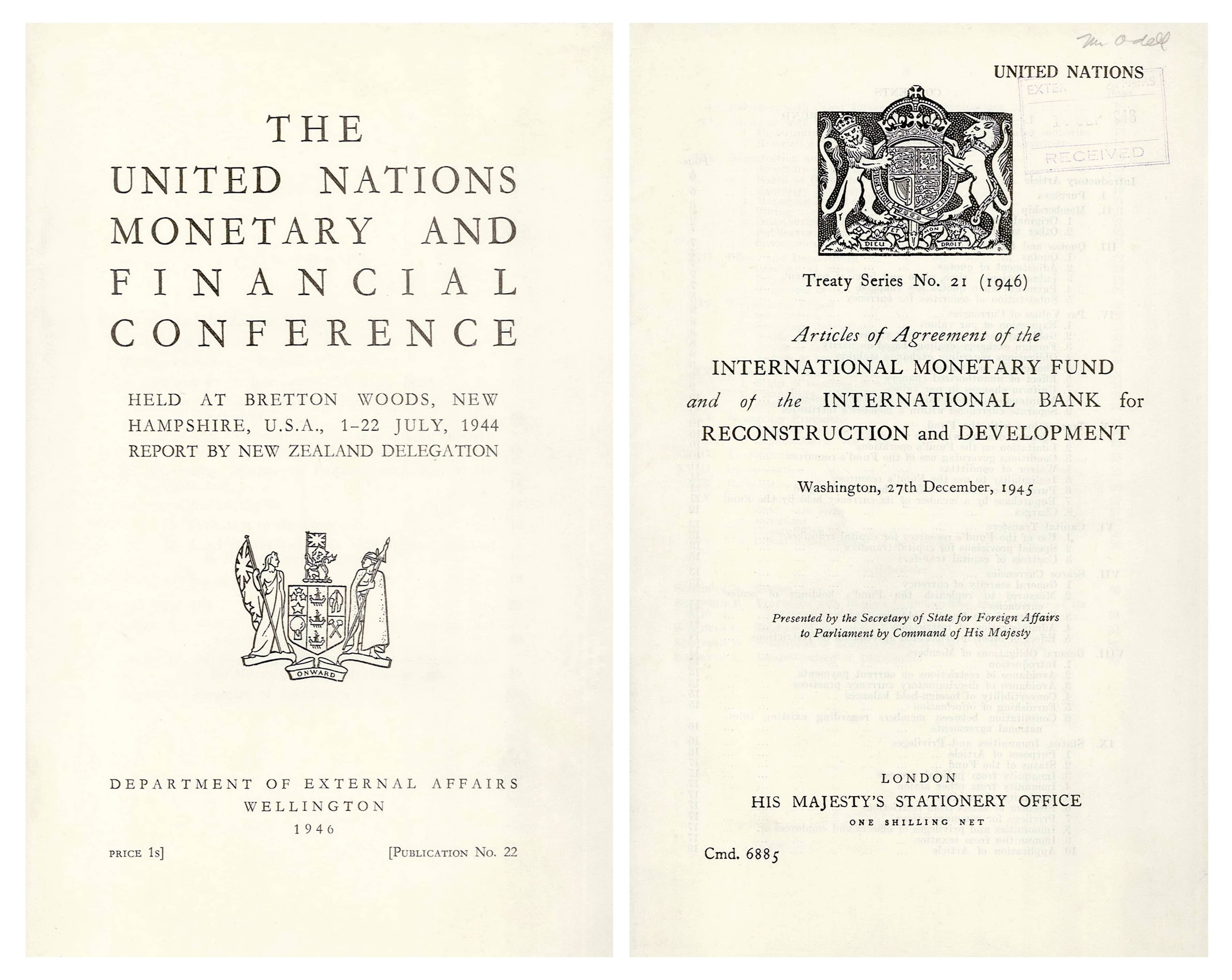
The 1944 Bretton Woods agreement made the US dollar the reserve currency for the world… the currency countries use to trade with one another. Image source: Wikipedia
Much of the rest of the world was rubble, particularly Europe and Japan. Each needed help rebuilding, and America was the only source of funding and material. The US funded the reconstruction of Europe and Japan, spending between 1946 and 1952 the equivalent of about $225 billion in today’s dollars.
Much of that money flowed directly back into America; it was the only real source of factories and manufacturing capacity that hadn’t been bombed back to the Stone Age.
And it was that money that fueled the rise of American suburbs and all the consumer demand for houses and cars and refrigerators and washing machines… and all the items that began to define the typical American middle-class life. The unwritten bargain had been written: work hard, play by the rules, and you’ll live a lifestyle the envy of the world.
All of that grew out of the same post-war moment—a unique event with no historical precedent, and which is unlikely to ever be repeated.
Bretton Woods bought America the cheapest money on earth. Every country in the world needed the dollar for trade, so every country was buying and holding US Treasury debt in reserve, demand for which kept US interest rates structurally low, allowing for cheap mortgages and cheap consumer borrowing for all those cars, refrigerators, and washing machines.
The concurrent rise of the middle class, meanwhile, bought America 80 years of relative domestic peace. No need to rock the boat when the boat is giving you a helluva good life. (I recognize America faced intense social issues, but that’s a different topic than the rise of the middle class.)
Today, the dollar’s primacy and US domestic tranquility, are running down together just as they ran up together.
We are now approaching an inflection point, where the dollar’s role globally changes, and where the middle class rebels against a system that has methodically eroded the American Dream over the last 40 years.
What we experience going forward is the story of those two changes occurring at the same moment.
That’s the crisis to come.
It’s a necessary crisis.
A cleansing to dismantle the architecture of policy decisions and tax laws that have created an American economy that favors the shareholding class over the working class.
That’s the remainder of the 2020s.
Which means the 2030s, as I see it, are shaping up as the most important revitalization of the American way of life since the late 1940s.
I do want to be clear here. The brighter 2030s is not a fate.
It’s a choice.
Not all crises lead to a rebirth. Some lead to a darker place. I mean, Germany’s post-World War 1 rebirth led to one of the most destructive moments in civilization. So, the choice ahead is entirely dependent on everyday Americans as well as a new class of politicians that will rise up in the 2030s as millennials and gen Z—the largest voting block in American history—take the reins from gen X and boomers.
If all goes as it should—and I am putting a lot of faith in Americans’ collective desire to rebuild the country—then we’re looking at a post-crisis America that is brighter, leaner, and more honest than what the country has built since the early 1980s.
For the last eight decades, the American standard of living has rested on two enormous subsidies—one external, one internal.
The external subsidy is the one that a French finance minister famously called America’s “exorbitant privilege”—the dollar’s role as the world’s reserve currency.
Because the world needs dollars to trade, the world has an endless appetite for greenbacks. In turn, that allows America to issue a quantity of debt that others cannot, and to issue that debt at interest rates that are unnaturally low (vast demand in the Treasury market, matched with America’s “full faith and credit” guarantee, means buyers willingly accept lower yields on the US debt they buy).
That is America’s “cheap money” fountain that has allowed Congress to runs deficits that would wreck other nations. It allowed the middle class to borrow cheaper than normal because low yields on Treasuries manifested as low borrowing costs on consumer loans, which are tied to what’s going on in the Treasury market.
In a nutshell: America’s exorbitant privilege let Washington finance an empire and a consumer paradise at the same time, while sending the bill for all of it abroad.
Now, the internal subsidy…
It’s more subtle, and arguably more important: Prosperity itself.
Rising, largely shared prosperity across the classes, particularly in the middle class, purchased generations of peaceful coexistence that has not always been the norm across history. Then again, honoring the rules of a system visibly delivering prosperity to you is pretty darn easy.
Your team loses an election? You accept it because the system doesn’t really change, and your life feels the same. It’s the “rising tide” theory at a socio-economic level. Your boat’s floating higher in the water no matter what—“I’m good with that,” the thinking goes.
That’s the system my grandfather bought into. The system he fought for as a Marine on Guadalcanal. The system that prompted him to scold a pre-teen grandson miffed that Gerald Ford interrupted prime-time television.
But when the system slips off track… or worse, when politicians running the system start changing the game legally to benefit their interests by extracting wealth from the middle class, that’s the fire in which revolutions are forged.
Years ago, economist Raj Chetty and his colleagues measured the most basic promise of this American life—the odds that a child grows up to earn more than their parents. For children born in 1940, it was roughly 90%. A near-certainty. For children born in the 1980s, it had collapsed to about 50%. A coin flip. What that stat doesn’t capture, however, is this sad reality: The Americans who today are earning more than their parents are losing ground nevertheless on the things that actually define a middle-class life.
The three pillars my grandfather’s generation took for granted—a home, a kid’s education, a doctor—have been repriced beyond what rising incomes can chase. In 1970, a median American home cost roughly 2.3 times the median household income. Today: 5.1—the highest ever recorded. A public college education has risen 2,600% since 1970, nearly 5x faster than general inflation.
And healthcare—barely a household line item when my grandparents raised me in the 1970s and 80s—now consumes roughly 9% of the typical American family’s income, while eating up 17% of the entire US economy.
The rising tide didn’t stop.
But it did stop lifting all boats.
For many Americans, they’re wealthier.
For many others, the system is purgatory’s waiting room… which is explicitly why American society today is riven by the so-called K-shaped economy. Those on the upper leg are doing fine, thank you for asking. But their compatriots on that down-slopping leg are losing ever more ground every day they’re still breathing.
That’s the decline of the American Dream in action.
That’s the system’s basic promise—work hard, live easy—dissolving into an arithmetic that no longer pencils out for so much of the middle class.
Now the question is: What’ll they do about it?
Even as American society now struggles with a deeply split economy, the government itself is working to kill the external subsidy—the dollar’s exorbitant privilege.
The intellectual architect is Stephen Miran, formerly Trump’s chairman of the President’s Council of Economic Advisers. In a November 2024 paper, Miran laid out the case for why the dollar is chronically overvalued. And it’s precisely because the world has been forced to hold the dollar and trade in the dollar for 80-plus years.
Because of America’s “strong dollar policy,” the dollar has been persistently overvalued for decades, which has had the perverse effect of hollowing out American manufacturing, which killed so many of our middle-class jobs.
America’s factory towns, it turns out, paid the hidden tax of the dollar serving as the world’s reserve currency.
On that topic, Miran is largely right in his diagnosis.
Where he and the current administration get it wrong is the cure.
The administration’s instinct—tariffs, pressure, a weaker dollar engineered on purpose—assumes America can have it both ways. That it can knock down the dollar’s value on the world stage to help rebuild American factories… while keeping the reserve-currency privilege that lets America borrow so cheaply.
That’s a two-piece combo not likely to survive contact with reality.
Reserve status is not something the US grants to itself. It’s what users have conferred on the dollar. But users can just as easily revoke the privilege. Britain, for instance, didn’t vote sterling out of its reserve role in the last century; the world simply moved on.
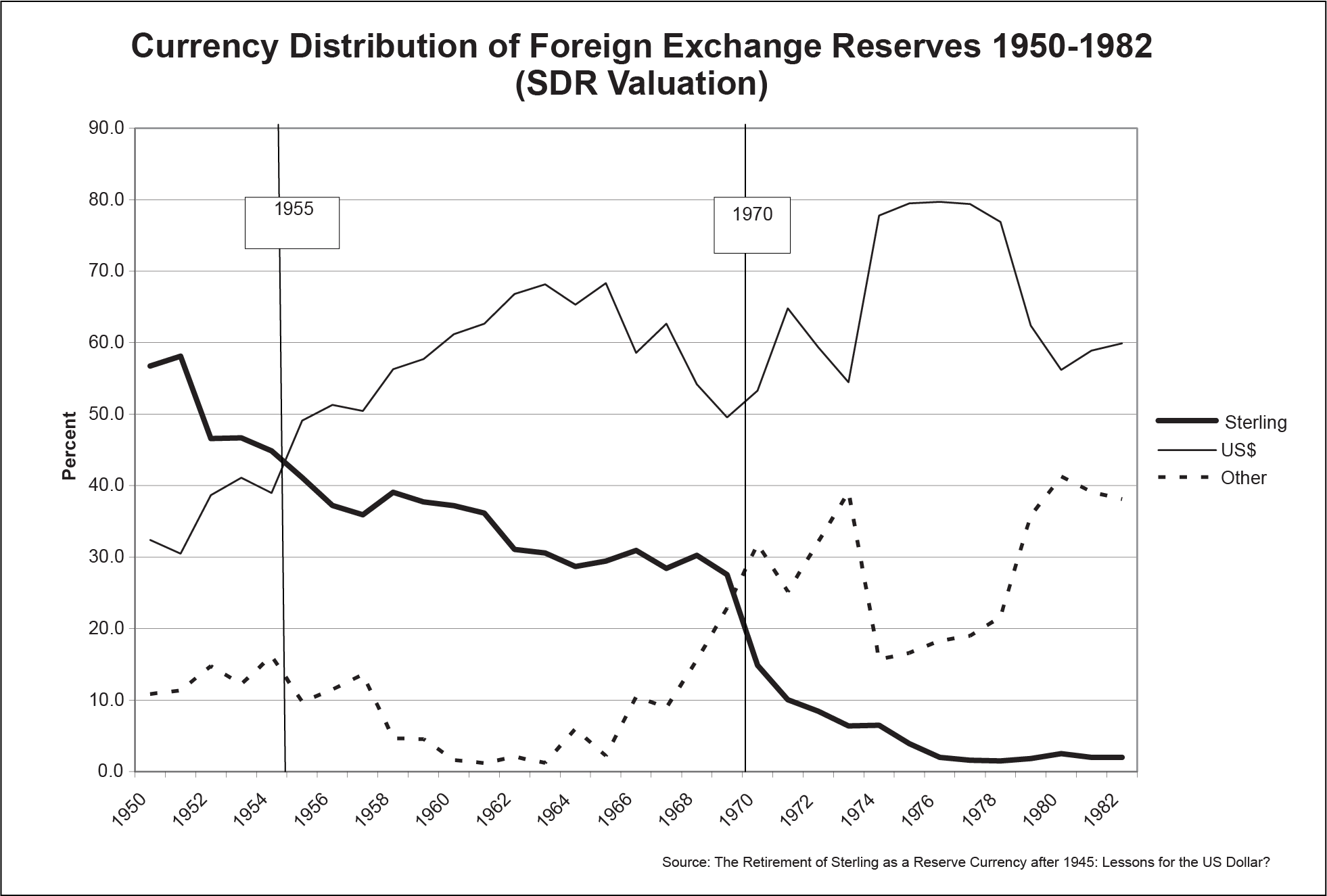
You can see how the dollar replaced sterling as the world’s reserve currency in the latter half of the 20th century. Chart: The Retirement of Sterling as a Reserve Currency after 1945
And if you think like a foreign central banker, you would of course ask yourself the obvious question: When the country that prints the reserve currency openly tells you it wants that currency to be worth less, why on earth would you keep holding it? To some degree, that’s functionally no different than a CEO announcing he thinks his own stock is overpriced.
I know that analogy isn’t perfect, but the imperfection highlights the dollar’s last line of defense.
Investors hold a stock for appreciation. Central banks hold the dollar because trade is invoiced in dollars, oil is priced in dollars, and the Treasury market is the only pool of bonds deep enough to accommodate trillions of dollars’ worth of demand… meaning the dollar functions more like an operating system on which the world runs its trade software.
Abandoning an operating system isn’t common, but it happens nonetheless when other alternatives emerge, and when the provider of the original operating system gives you a reason to switch.
America gave the world reason to switch in 2022, when it led the Western effort to freeze roughly $300 billion of Russia’s central-bank reserves after the invasion of Ukraine.
Every finance ministry around the world understood the lesson instantly: Dollar reserves can be confiscated at any time, and with no recourse.
That single act did more to spur de-dollarization than any other US action in decades, because the Biden administration turned the dollar from a neutral asset into a political weapon.
“China, Singapore, Thailand, the United Arab Emirates, India, Saudi Arabia, and others are all working to deploy new ways of moving money globally that bypass the dollar completely.”
Now, alternative financial plumbing is emerging globally. China, Singapore, Thailand, the United Arab Emirates, India, Saudi Arabia, and others are all working to deploy new ways of moving money globally that bypass the dollar completely. They’re creating infrastructure that didn’t exist as recently as five years ago, and already billions of dollars of equivalent currencies are flowing through those pipes.
And while the dollar still accounts for roughly 59% of global reserves, the moves that are visible globally right now speak to an ongoing migration—the slow, compounding construction of exit ramps that methodically move trade away from dollar systems.
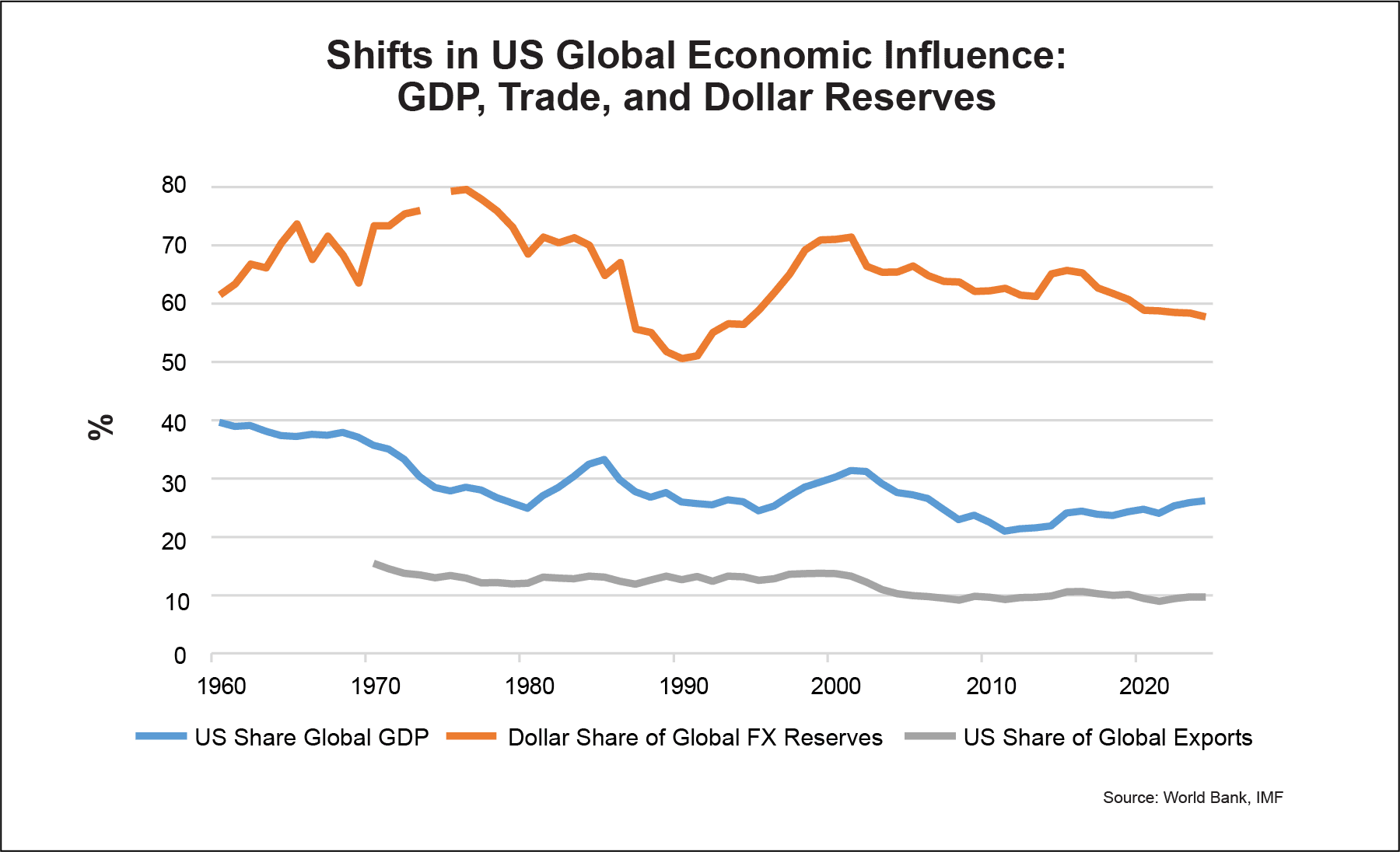
The dollar today sits at just under 60% of global reserves. Chart: European Parliament briefing (2025)
We won’t see a collapse tomorrow. That’s not how this works.
Instead, we will see, as we already are, the erosion of trust in the dollar because of DC and countries that are increasingly choosing to function—in full or in part—on non-dollar infrastructure. Meaning that the cruel irony here is that Washington, by leaning on coercion to defend the dollar, as has been its strategy for years, is handing the world the motive to leave.
The world is responding to that by building the tools to do so.
On the home front, meanwhile, a similar pattern is playing out at a different scale.
As the internal subsidy of shared prosperity disappears, so does the stitching that has held America together and which is now clearly fraying in polls that show Americans on either side of the aisle now see the other side as detestable and evil. Yes, those are real polls from surveys conducted by Johns Hopkins University, Pew, and others.
But maybe the purest manifestation of America’s broken society is a poll from the Listen First Project finding that 20% of Americans say members of the other political team “lack the traits to be considered fully human.”
Tell me the glue holding America hasn’t rotted away.
The deepest truth about modern America isn’t that one tribe is evil. It’s that the consent of the governed is being withdrawn structurally, from every direction. Lessons from history tell us that’s how countries tear themselves apart.
It’s here where I turn this month’s dispatch away from two crises unfolding at once. This isn’t an external and an internal sunset running in parallel.
They’re braided.
They exist because of each other and they threaten to amplify one another into a Perfect Storm kind of crisis.
The dollar’s recalibration is coming regardless of who governs in DC. A smaller global footprint, a weaker currency, the end of the exorbitant privilege—those are all baked in at this point.
In turn, that exacerbates the impact of what I’ll call “paycheck rot” that American families feel. A weaker dollar drives inflation higher simply because the cost of importing all the goods Americans buy goes up. It’s just math.
All of which means…
The 2030s are shaping up as the post-dollar age.
And that is a good thing. A very good thing.
That is America’s brighter future waiting on us to arrive.
Strip away the dollar’s exorbitant privilege and you also strip away the flaw that let Washington neglect its own people for decades: cheap financing.
Sure, cheap financing sounds like a gift. It wasn’t. It was Washington’s permission slip to avoid every hard choice about who the economy actually serves. DC could run unlimited deficits without immediate consequences—no bond market revolt, no currency crisis, no political accountability—because captive foreign buyers kept soaking up Treasury debt no matter how reckless the American fiscal situation.
That removed the one mechanism that would have forced Congress to make hard choices about how it spent money and who it served.
What did Congress do with that freedom from consequences?
It spent on the things that benefit organized, concentrated interests—defense contractors, financial sector bailouts, corporate tax architecture, pharmaceutical pricing protection—while neglecting the diffuse, unorganized interest of the middle class, which doesn’t have a lobbying army.
The cheap money didn’t trickle down. It funded the financialization of the economy: asset price inflation that made the already-wealthy vastly wealthier, while wages for working Americans stagnated in real terms.
And it directly de-industrialized America.
A perpetually, if artificially strong dollar is the most significant factor that led US companies to begin to move production overseas, where costs were vastly cheaper than at home, where the strong dollar forced prices higher for input costs. The manufacturing base—the engine of postwar middle-class prosperity—hollowed out in part because reserve currency status made it structurally uncompetitive.
So the exorbitant privilege that built the middle class is the exact same privilege that has torn it asunder.
If the privilege goes away, the dollar’s structural burden dies too.
And however painful the transition to a non-dollar global order—and it will be painful in the short run—that’s how America finds its way back to the prosperity it lost.
When the dollar is no longer conscripted into its role of serving the entire world, it can finally serve the country that issues it.
American know-how doesn’t evaporate. The grit, the technical depth, the capacity to build—none of it goes away.
A cheaper dollar, an unavoidable and desirable byproduct of this transition, makes existing American producers more competitive almost immediately (though the deeper manufacturing renaissance will still take a decade or more to mature).
Stripped of the exorbitant privilege, America will be forced to fix its crumbling house, mainly because it can no longer afford not to.
That is not a poorer America.
It is a more humble, more honest American government—and a potentially far better America.
So here’s my bet: The decline so many Americans sense is real, but collapse won’t be the path in 2030—precisely because the crisis is going to force a rethink of how the economy functions and, more importantly, who it serves.
There will be a rethink globally and within the halls of Congress about the dollar’s role as king of the jungle, and that’s likely to end with a realization that by removing “reserve currency” from the dollar’s business card, America can actually fashion a stronger economy and stronger currency. Look no further than the Swiss franc—it’s not the global reserve, but it’s a damn strong currency supporting one of the most robust economies on the planet. (And that’s why it’s part of our portfolio.)
That’s my bet. That’s my optimism—because I am genuinely optimistic about the America that emerges next decade.
Our Global Intel portfolio is already well positioned for the crisis and transition to come.
The reshoring that happens under a weaker dollar and the electrification that a rebirth of American industry demands—as well as global AI trends—play into assets we already own: specifically silver, uranium, and copper. They all sit at the epicenter of that.
Southern Copper is up 170%. Silver bullion is up 115%. And Antero Resources, a small-cap uranium miner, is up only 4%, but we’ve only held it a few months, and those are months in which uranium and other stocks have been impacted by the war in Iran.
We’re also in gold and Swiss francs.
Both are winners here because both are non-dollar investments that rise in value as the dollar declines. So in a world where crisis is leading America to a structurally weaker dollar, both francs and gold continually push higher.
This month we’re going to add to and strengthen our portfolio by buying the Singapore dollar, one of the strongest and best-managed currencies in the world.
First, I will tell you about the ABF bond fund…
Place a market order to buy this fund at the existing price. This is a currency ETF and it’s not going to move dramatically from one day to the next.
You will notice that the ticker symbol, A35, seems odd. And it is—it’s not a ticker you’d find in the US. And that’s because to own this one, you need to have an account at either Schwab, Fidelity, or Interactive Brokers, which all offer direct access to the Singapore Stock Exchange.
However, you will likely need to call the firm and speak to a specialist on the international trading desk and ask them to place the trade for you. I know by way of my own Fidelity account that you cannot simply insert A35 in the search bar and pull up the quote from this fund.
I’ve given this investment a low-risk rating because, as I noted, this is a currency ETF. So, you’re buying currency, and currency does not swing by large amounts. In the last year, for instance, the fund has ranged between S$1.168 and S$1.108. Also note that foreign shares, especially in Asia, routinely trade at prices that would make them seem like penny stocks; they are not. It’s just a function of the fact that Asian companies routinely sell billions of shares while US companies are often in the tens or hundreds of millions.
As for the fund, it’s just a vanilla bond fund widely used as a proxy for the Singapore dollar. There’s nothing to this fund more complicated than that.
If you want to own Singapore dollars directly, then use Moneycorp. I’ve mentioned Moneycorp in the past. It’s a money transfer service, generally used by folks who are moving larger sums of money abroad to pay for a house purchase overseas or whatnot. But you can also convert dollars into various currencies, such as the Singapore dollar, and just let the cash sit in your account. That is not Moneycorp’s core business, but they don’t balk at the strategy.
You can find Moneycorp online here.
(Full disclosure: This is International Living’s affiliate link, and IL may receive a fee if you sign up. This does not affect the exchange rate you receive from Moneycorp.)
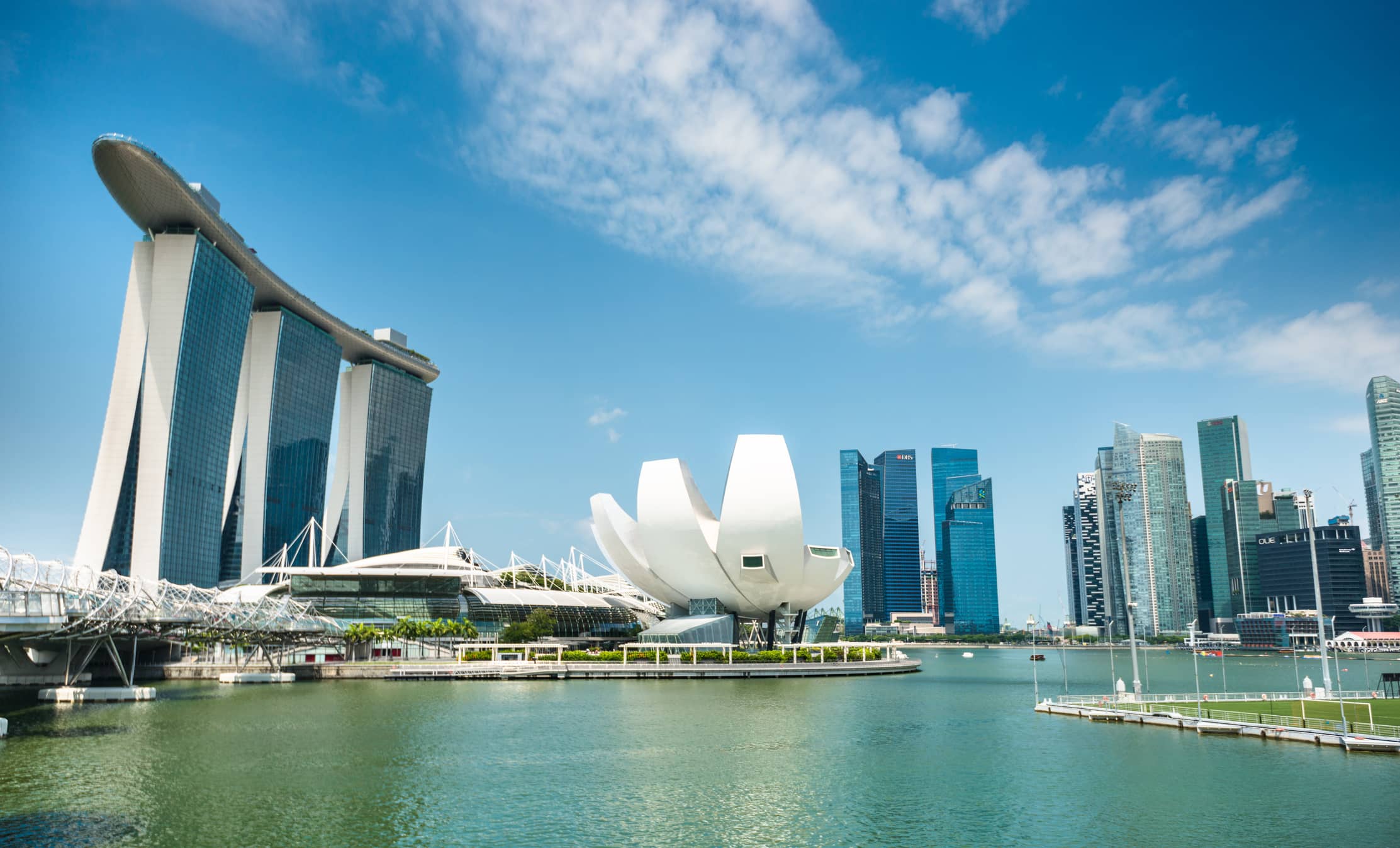
Singapore is a premier financial hub… and Singapore’s dollar will be a winner when USD lays down its burden as the world’s reserve currency. © iStockPhoto.com/gollykim
Why Singapore?
The island nation has spent 60 years building itself into the world’s most indispensable economic middleman—a top-tier, rule-of-law financial hub where East meets West, where capital flows effortlessly between China and America/Europe, where multinationals park their Asian headquarters precisely because Singapore answers to no one’s geopolitical agenda.
Moreover, the Singapore dollar and the yuan have moved in tighter sync than any other Asian currency pair, while simultaneously maintaining a deeply inverse correlation with the US dollar. That’s Bloomberg’s analysis from April 2026.
So, when we’re looking toward a future where the US dollar steps back from the role of Atlas holding the world on its shoulders, the Singapore dollar (along with the Swiss franc) is one of the currencies most likely to win.
To be clear, this is not a shoot-the-lights-out investment. Again, this is currency. It will move methodically. Our play here is simple: As the dollar’s value ratchets lower, the Singaporean will ratchet higher in relation, so that when you cash out, you will collect more US dollars than you started with.
Finally, let me end by offering you a warning about the investment I absolutely do not want to own going into this next decade: long-dated US Treasuries, meaning any government bonds with a maturity longer than two or three years.
When fear hits, the historical reflex has been to park cash in long-dated US Treasuries.
But in the crisis I’ve laid out, that reflex is a trap.
When the exorbitant privilege dies, the world’s “risk free” asset—US Treasury paper—becomes the asset carrying the most risk.
Safe-haven status becomes toxic.
As I noted early on, there is a crisis to come before this decade is out—but this month’s issue is not about a descent into darkness.
Yes, a dollar crisis seems inevitable at this point, but that crisis is going to lead us to better and healthier America.
And if you position yourself in the right assets, your portfolio is going to end up in a better place too.
Finally, let me say that if you’re interested in learning much more about how I think the 2030s could play out in America—and how to prepare your portfolio to profit, in the short and long term—I’ll be devoting a whole day to the topic at my upcoming Future of Wealth Summit in Ireland. Tickets are still available—right here.
For this month’s Portfolio Review, I want to step back from individual stocks and talk about the market as a whole—and how it might be impacted by the Federal Reserve’s next move: whether it raises or cuts interest rates.
We’re in a unique situation and I’m not sure where we’re really headed.
I say that because of the mixed messaging flowing from the Fed.
In one corner we have Austin Goolsbee, president of the Federal Reserve Bank of Chicago and a member of Federal Open Market Committee, the FOMC, which is the body that meets to move interest rates around.
In the other corner, Kevin Warsh, the Trump-appointed Fed Chairman who just took over in May from former Fed Chair Jerome Powell. And the only reason I note his Trump connection is because it plays into the mixed messaging.
A few weeks ago, Goolsbee said that inflation in America remains too high and that in balancing the Fed’s dual mandate—inflation and protecting jobs—“clearly the problem is on the inflation side.” The implication: The Fed might need to raise interest rates… soon.
And then there was Warsh, who was in Sintra, Portugal recently for a European Central Bank Forum. He was a bit performative in his assurance that the Fed remains independent, despite Trump’s incessant calls for lower interest rates and claiming that Warsh is his guy in the Fed. Warsh nodded to inflation remaining a problem, but nevertheless said inflation expectations are falling and that AI will be a productivity boon that shrinks inflation even more.
So we have Goolsbee talking about a situation that would call for raising interest rates, which would slam Uncle Sam because US debt repayment costs would go up… That would be bad for the dollar ultimately.
And we have Warsh talking about a situation that would call for lowering interest rates, which would reduce the dollar’s appeal to global currency traders who would sell the dollar to collect higher interest rates on currencies like the euro, the pound, and others.
As such, the market is betwixt and between. Are rates going up or down? And when?
The economy itself isn’t faring all that great. Jobs numbers have been decidedly weak, with significant downward revisions of earlier data. The Atlanta Fed’s GDPNow tracking tool expects Q2 GDP growth to come in at just over 1%. Consumer sentiment sits at some of the lowest readings in the last 75 or 80 years. Consumer and business bankruptcies are rising, and the US housing market is in a deep structural slump, defined by record-low transactional volume and severe affordability constraints.
That calls for interest rate cuts.
However, inflation remains a persistent bugbear. The most recent report shows inflation surging more than 4.2% on an annualized basis. To get the same amount of goods or services $1 bought at the end of 2021, now requires that you spend $1.28… yet for every $1 you earned at the end of 2021, today you are only earning $1.20. Inflation outpaced your paycheck.
That calls for interest rate hikes.
So what I’m saying is that we’re in no man’s land.
We won’t really know which way the wind is blowing until we see what the Fed does over the next couple of meetings.
My bet is that the Fed cuts, before it raises. A raise would cause so many painful knock-on effects for the cost of running the government. The US would have to borrow trillions of dollars more over the next 10 years or so to pay for higher interest rates… and that hastens the currency crisis American faces.
But that is not a high-conviction bet. There’s just too much crossfire between what different Fed governors say, and what the economic data is showing.
I tell you all of this to impart one message: Don’t be rash. If the market moves down on some news, don’t sell just because the ticker tape is bleeding red.
This is a temporary moment, and I suspect the Fed wants to see what happens when the war with Iran is over—like, officially over. That will begin to lighten some—not all—of the inflationary pressures, which give the Fed cover to cut rates to deal with the economy.
Like I said, though, that is not a high-conviction call.
So, just sit on your hands until we have a clearer picture of where the Fed is leaning.
Here’s to living richer,
Jeff D. Opdyke
Editor, Global Intelligence
© Copyright 2026. All Rights Reserved. Reproduction, copying, or redistribution (electronic or otherwise, including online) is strictly prohibited without the express written permission of Global Intelligence, Woodlock House, Carrick Road, Portlaw, Co. Waterford, Ireland. Global Intelligence Letter is published monthly. Copies of this e-newsletter are furnished directly by subscription only. Annual subscription is $149. To place an order or make an inquiry, visit https://internationalliving.com/page/faq/. Global Intelligence Letter presents information and research believed to be reliable, but its accuracy cannot be guaranteed. There may be dangers associated with international travel and investment, and readers should investigate any opportunity fully before committing to it. Nothing in this e-newsletter should be considered personalized advice, and no communication by our employees to you should be deemed as personalized financial or investment advice, or personalized advice of any kind. We allow the editors of our publications to recommend securities that they own themselves. However, our policy prohibits editors from exiting a personal trade while the recommendation to subscribers is open. In no circumstance may an editor sell a security before our subscribers have a fair opportunity to exit. The length of time an editor must wait after subscribers have been advised to exit a play depends on the type of publication. All other employees and agents must wait 24 hours after on-line publication prior to following an initial recommendation. Any investments recommended in this letter should be made only after consulting with your investment adviser and only after reviewing the prospectus or financial statements of the company.