Dear Global Intelligence Letter Subscriber,
November, 1910. A secret gathering of high-powered bankers—at the posh Jekyll Island Club, off the coast of Georgia.
The plan: To build a central bank for a country that had experienced 33 recessions, depressions, and financial panics in the 137 years since its founding.
That was how the idea for the US Federal Reserve began…
At that secret meeting, the bankers who gathered on that Georgia island created the monetary system we still use today.
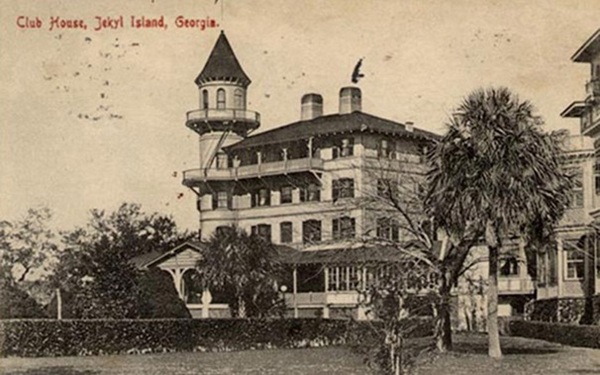
The Jekyll Island Club, Georgia. Source: federalreservehistory
However, as bankers of the day running J.P. Morgan Co., National City Bank of New York, and others pieced together the plan for a unique American central bank that existed outside the walls of government… Others were concerned.
Charles A. Lindberg, Sr., for one—father to the famous aviator—repeatedly warned that everyday Americans would come to rue the day that Congress gave life to this particular creature.
Lindberg served as a DC congressman representing Minnesota for a decade between 1907 and 1917. But he’s perhaps best known for being one of the more-vocal dissenters in the birth of what one writer would later call “the creature from Jekyll Island.”
What were the objections to a Federal Reserve?
Some, such as Massachusetts Sen. Henry Cabot Lodge, foresaw a politization of the currency and government overreach that would undermine state banks. Others saw the potential for corruption and the creation of economic divisions in society.
But Lindberg saw the bigger picture: a "money trust," outside the government’s direct authority, controlled by large Wall Street banks that would dominate the economy and exploit the public, and which ultimately would lead to financial concentration benefiting the wealthy elite at the expense of farmers, small businesses, and average American families.
In 1913, the Fed, a quasi-public, quasi-private institution took control of the US money supply and, by extension, the US economy.
Ten years later, Lindberg published his book, The Economic Pinch, and offered what I see as the most accurate warning in American financial history: A dollar that the Federal Reserve bank alone controls cannot be honest.
An honest dollar.
The concept refers to pre-Fed money, when US dollars were backed by gold or silver… when the currency maintained predictable purchasing power over time, free from arbitrary manipulation by the government of its agents, and not subject to any form of debasement such as inflation (money printing) that erodes its value.
Now here we are today, 112 years after the Fed’s birth, and America’s once-honest dollar has lost about 97% of its purchasing power to inflation—a never-ending ski slope down (see the second chart below)—a problem that never existed in America before the Fed.
Meanwhile, the monetary system the Fed created—built on “elastic money”—has allowed the government to accumulate an astonishing sum of debt, set to surpass $40 trillion in the next two years, nearly $350,000 per American taxpayer.
In short, America is racing toward a “Come to Jesus” moment that promises to fundamentally change the US dollar and potentially upend daily financial life for American families in ways that too few Americans truly appreciate.
But this Fall double-issue of Global Intelligence isn’t about America’s debt. It’s about the impact the debt is already having on the global value of the US dollar, and where we all should stick some of our dollar-based wealth to escape the crisis to come and to benefit as that crisis unfolds.
Two moments in American financial history explain why we are where we are today.
#1. That secretive Jekyll Island meeting
I want to punctuate my comments about the Fed with two charts. They help explain how we’ve reached the point we’ve reached today, and they offer insight into where we’re headed…
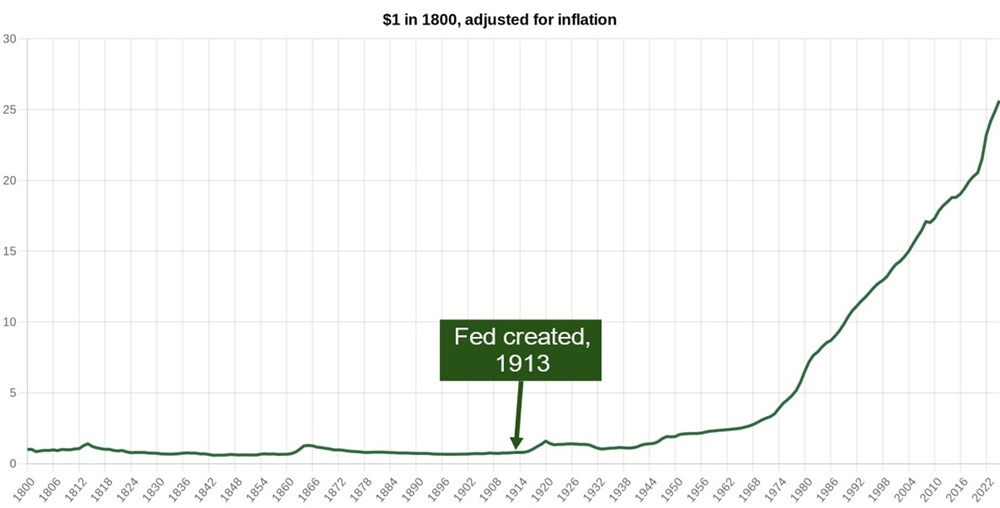
The rise and rise of inflation.
That green line tracks the value of $1 adjusted for inflation going back to 1800.
The uptrend post 1913 is bad!
Between 1800 and 1912, the dollar was a highly stable currency, as you can see from that fairly straight line. While the US economy experienced episodes of inflation tied to wars and such in the decades before the Fed’s birth, the dollar’s purchasing power never collapsed. In fact, a dollar from 1800 bought about $1.20 worth of goods in 1912—meaning it was more valuable 112 years later, not 97% less valuable.
Today, consumers need about $30 to buy what a dollar once bought before the Fed came along with its design on creating what would eventually evolve into a permanent state of inflation. (The green line’s constant uplift is proof of the constant state of inflation.)
The second chart:
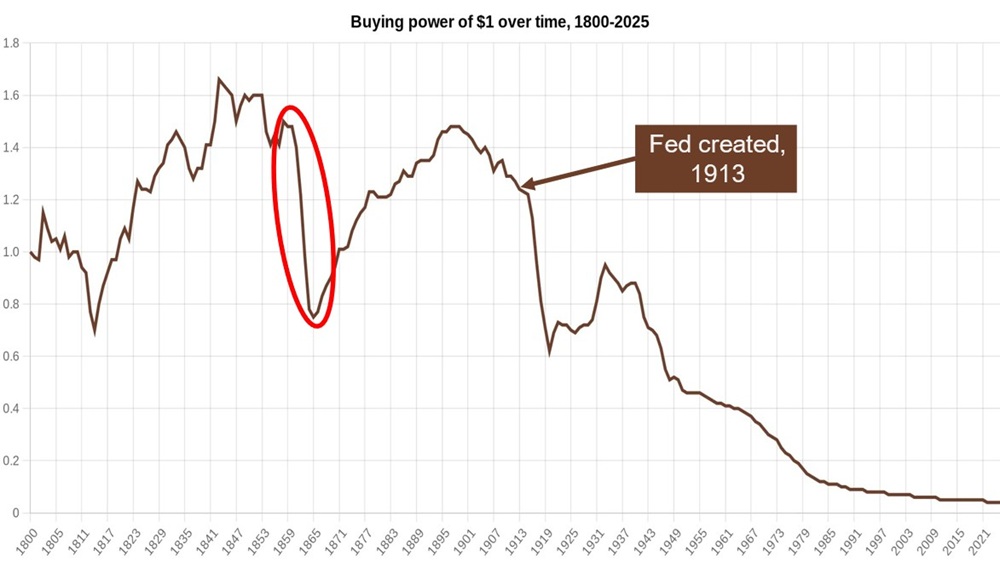
The death of $1.
The brown line tracks a dollar’s purchasing power since 1800.
In this case, the post-1913 downtrend is bad. Very bad!
This is the “ski slope” down I mentioned in the intro, and it implies that the Fed has engineered a system purposefully designed to methodically destroy the dollar’s purchasing power over time.
You can see that between 1800 and 1912, the dollar’s purchasing power certainly bounced around, but that it ended up pretty much where it began. Since the Fed’s creation, however, the dollar’s purchasing power has continually drained away to the point that $1 just before the Fed came into existence would buy about 3 cents worth of goods today.
“Inflation continually erodes wealth like running water continually erodes a stone.”
That’s the function of permanent inflation. Even if inflation amounts to what the Fed calls a “moderate” 2% per year, the devaluation never stops, and the accumulated damage continually erodes wealth like running water continually erodes a stone.
By the way, that collapse I’ve circled in red… that’s the Civil War, when the federal government suspended the gold standard and began printing money hand over fist to afford mad spending on troops, weapons, munitions, food, uniforms, and the like. But notice that the trend was never an unending ski-slope down. The moment the war ended, the government stopped printing bags of money and returned to the gold standard… and the dollar’s purchasing power rebounded smartly.
And then along came the Fed to create “currency elasticity,” or a money supply that stretches and contracts with business cycles.
At that time, America backed every single dollar with 25.8 grains of 90%-pure gold. With gold then valued at a government-imposed $20.67 per ounce, those golden grains were worth exactly $1. Thus, every US dollar was worth precisely a dollar’s worth of gold.
That arrangement, however, hamstrung the banking industry’s capacity to react to economic ebbs and flows. The bankers supporting the Jekyll Island initiative wanted the power to create money from nothing, to inject cash into the economy when it struggled, and to pull it out of the economy when it ran too hot.
They wanted a fiat currency.
One backed by nothing, and certainly not backed by gold.
Under a gold standard, the money supply could only increase to the degree that the federal government’s gold supply increased. Under a fiat system, the banking industry, under the stewardship of the Fed, could simply will money into existence.
#2. The Bretton Woods Accord
In 1944, global governments met at a resort hotel in Bretton Woods, New Hampshire to hammer out a post-World War financial system. Devastation blanketed Europe; not much better in Japan. America was the only significant economy physically unscarred by war… meaning it had the manufacturing base capable of helping rebuild the world.
By extension, that meant America had the only major currency that war hadn’t destroyed and which could serve as the grease to lubricate global trade.
Thus was born the dollar’s status as the world reserve currency—the money all countries would henceforth use when trading back and forth between each other.
If Great Britain wanted to buy rice from Thailand, the deal would clear in dollars. If Japan wanted to buy machinery from Germany, the deal would clear in dollars. That arrangement put the dollar and New York’s banking industry at the epicenter of world trade. Every transaction in dollars had to route through New York—a situation that would return to haunt America 80 years later.
At the time, however, the upshot was that the US emerged as one of the strongest currencies in the world by dint of forced demand. Had the dollar not taken on the role of global reserve, and had countries simply traded amongst themselves in their own local currencies, the dollar would have seen no demand beyond the natural demand for trade between the US and individual countries.
But when every country on the planet is buying dollars to facilitate their trade, even with non-US trading partners, demand for greenbacks is unnaturally strong, keeping the dollar elevated.
Over the decades, that strength has actually undermined the American economy and the American middle class.
Because of dollar strength, US manufacturers started looking for countries where they could make their products less expensively because of lower labor costs, which would help keep US products more affordable to foreign buyers.
The middle class began to lose ground.
Middle-class jobs vanished.
Wages in America began to stagnate.
Lifestyles largely remained elevated because foreign manufacturers began producing quality, low-cost items that kept consumer prices low in America, allowing a shrinking and less-affluent middle class to still afford new clothes, new cars, and electronics from low-cost Asian producers.
But the dollar’s reserve currency status, and America’s unyielding appetite for low-cost foreign goods, also meant that countries built up vast reserves of US dollars, which they converted into US Treasury paper. That constant demand kept the dollar’s value higher while keeping yields unnaturally low on American debt.
Uncle Sam’s financial stewards—the clown show known as Congress—saw those low rates and the unending demand for American debt as a cheap source of borrowing. And borrow they did—in abundance—starting with Ronald Reagan. At the end of 1980, just days before Reagan took up residence in the White House, America owed just over $900 billion, a paltry 35% of the country’s GDP at the time.
Forty-five years later, debt now approaches $37.3 trillion, or nearly 125% of GDP.
The economy grew roughly 12-fold.
Debt grew more than 41 times larger.
All of which lands us where we are today: A dollar burdened by extreme debts and controlled by a quasi-governmental agency (the Fed) that purposefully and methodically devalues the currency by printing money… and which, not incidentally, has fueled the ire of the current US president.
And all of that is why reducing our exposure to the dollar is a necessary prescription for protection today.
Here’s where we now stand:
That’s not just my worry. The Trump administration sees the same and has openly stated that a weaker dollar is the path for bringing manufacturing back to America—part of Trump’s America First agenda. Whether that works out the way the administration assumes it will is another issue, but either way we must pay attention to the administration’s goal of a weaker dollar.
If the administration actively pursues a weaker dollar, or if it quietly allows the dollar to weaken against global currencies, then we want exposure to currencies other than the dollar, to offset the inflation that happens in America.
The US imports lots of raw and finished products for which there are no locally sourced substitutes (bananas, coffee, cocoa, manganese, mercury, graphite, so many others). As the dollar declines, the cost of buying those items goes up in dollar terms—i.e., inflation.
Simply put: Under a weak-dollar regime, the dollar loses value against global currencies.
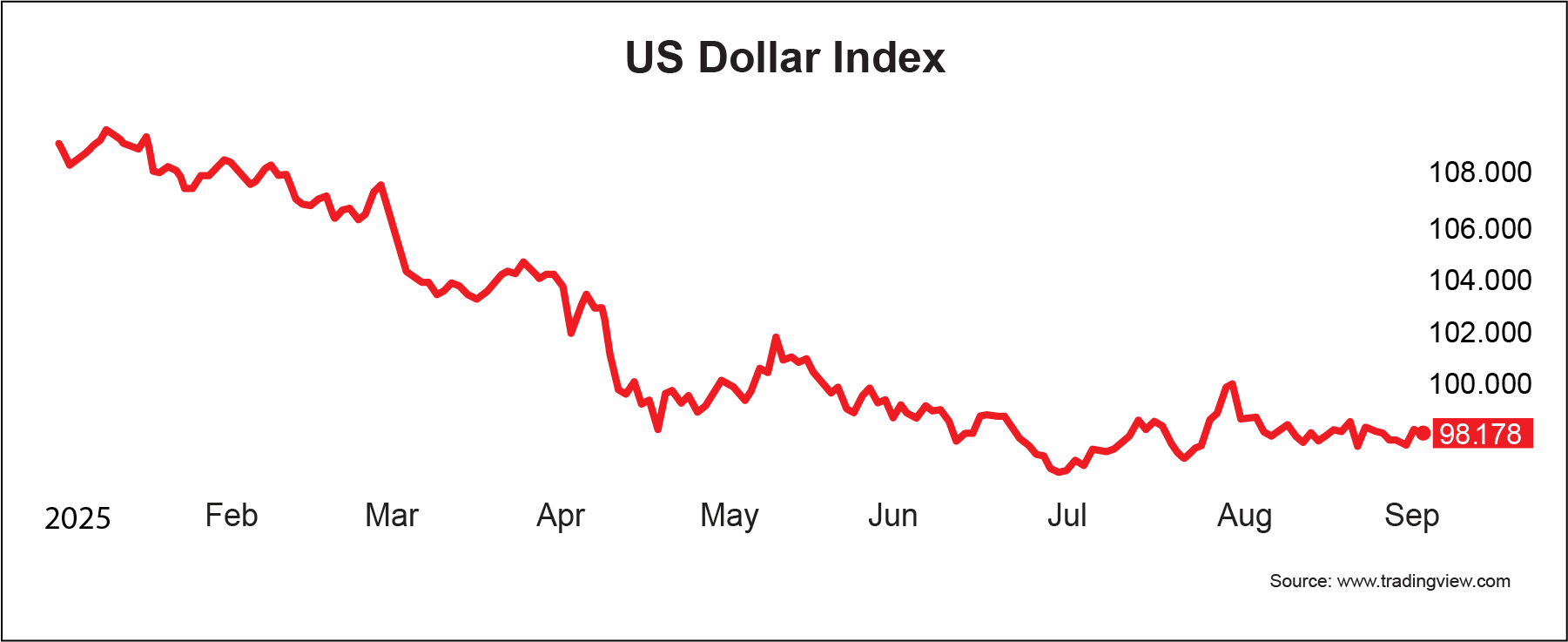
Trump has signaled he wants a weaker dollar… and USD is already down 10% this year against a basket of major currencies.
There are concerted efforts all over the world to reduce the dollar’s role globally. The BRICS nations, led by China and Russia, are building a new reserve currency to compete against the dollar, and numerous countries have already begun trading amongst themselves in local currencies, rather then using the dollar as the go-between.
India and the United Arab Emirates are trading oil in rupees. China is buying oil from Saudi Arabia in Chinese yuan; and for the first time ever, China’s global trade is denominated in yuan more than in US dollars, meaning much of the rest of the world is clearly willing to bypass the dollar.
The Association of Southeast Asian Nations (ASEAN) is pushing forward with plans to trade in local currencies rather than the dollar, and several central bank projects around the world are aiming for blockchain/crypto-based systems that will allow trade finance to happen near instantaneously in local currencies and without the need for the dollar.
Meanwhile, a large majority of central banks reported earlier this year that they’ve been methodically whittling down their dollar exposure and building up their exposure to gold.
All of those efforts speak to a weakening dollar.
And they’re requiring Uncle Sam to take on additional borrowing just to afford the interest payments on Treasuries.
At extreme levels of debt, even small interest-rate increases have outsized impacts.
As of mid-summer, the US paid an average interest rate of 3.4% across all its debt. Just three years ago, the rate was 1.6%, meaning Uncle Sam’s interest rates have more than doubled.
Equally important, those higher rates are spread across a larger sum of debt: $37-plus trillion today vs. just under $31 trillion three years ago.
The upshot is record interest payments: $475 billion in 2022 vs. $1 trillion this year, more than 15% of the federal budget, the highest level outside of war.
Because of that…
Foreign central banks have been selling US debt to buy gold instead, a hedge against ongoing dollar weakness.
Foreign private investors—think: overseas pension plans and other institutional investors—have been net sellers of Treasuries as well.
Declining demand has seen weakening interest among foreign buyers at recent US Treasury auctions. As Business Insider put it in a June headline: 'Cracks' are forming in foreign demand for US Treasury bonds…
The publication, quoting a Bank of America analyst, noted that, “Foreign participation in the most recent US 20-year Treasury auction was the lowest since July 2020,” during the COVID pandemic, when the global economy was shuttered.
In turn, the US is having to offer slightly higher interest rates to create demand for its debt, increasing America’s already strained debt-payment costs.
If this trend continues, the Federal Reserve will likely step in as buyer-of-last resort, which would imply printing money to buy Treasury debt, which pumps money into the economy, stoking inflation even more.
Investors backing away from the dollar means they are selling dollars or not buying the dollars necessary to invest in US Treasuries… and that selling pressure and lack of demand pushes the dollar lower.
The jobs market is crumbling, as per recent Bureau of Labor Statistics data. And the number of workers is in decline because of Trump’s deportation agenda, which is removing millions of workers in agriculture, construction, hospitality, healthcare, and elsewhere in the economy.
Loss of workers is inflationary and retards economic growth. Employers have to pay higher wages to attract workers, and with a shrinking base of workers, employers cannot expand, which limits economic growth.
At the same time, producer prices are rising sharply because of tariffs, and that’s going to show up in consumer prices going into the fall and winter, and then into 2026.
Moreover, a number of large retailers and consumer-product companies—Walmart, Home Depot, Target, Best Buy, Stanley Black & Decker, Nike, Procter & Gamble—have all announced prices are going up because of the affect tariffs are having on their cost structure.
All of that points to a period of stagflation, which I’ve been warning is coming for America.
As such, the Fed is boxed in.
Address the weakening jobs market with interest-rate cuts and inflation worsens… which ultimately raises US debt-repayment costs because investors will demand higher interest rates in the financial markets to compensate for the loss of purchasing power due to inflation. That will raise rates on mortgages, auto loans, and credit cards, making financial life even more challenging for Americans. (Note: There is a difference between the Fed Funds interest rate the Federal Reserve sets, and the interest rates the market demands when buying Treasuries.)
Address the inflation factor by raising rates, and the economy suffers while interest payments rise. Bankruptcies would increase at the corporate and personal level, and Uncle Sam would be shelling out billions of additional dollars in debt-repayment costs, forcing the government to borrow even more heavily just to afford the higher debt payments.
Either way, the dollar loses value because investors will be increasingly worried about a debt/monetary crisis in America.
Trump, the self-proclaimed King of Debt, abhors high interest rates and any move by the Fed to raise rates would draw even greater ire from the president.
Already, he is continually badgering current Fed Chair Jerome Powell to cut rates to 1% from 4.5%—a massive reduction that would be inflationary.
The bigger problem, however, is perception.
The Federal Reserve was designed to operate independently of government so that political whims don’t impact interest-rate decisions.
Trump doesn’t care about such protocol. He wants what he wants, even if it makes no sense economically. He has already nominated Stephen Miran as a new member of the Fed board. Miran, who Trump named to head the Council of Economic Advisors, is the architect behind Trump’s weak-dollar desires and will clearly do Trump’s bidding in pushing interest rates lower.
Moreover, Trump has signaled that he wants to replace Powell with someone more in tune with Trump’s desire for lower interest rates. In August, he also fired—or attempted to fire (it’s still in the courts)—Federal Reserve Governor Lisa Cook, further indication that Trump is hellbent on shaping a Federal Reserve Board that will bend the knee to his will, regardless of how ill-advised that is.
The risk here is that investors no longer see the Fed as an independent body but instead as a tool for Trump to manipulate as he sees fit.
If that happens, the US is no better than a developing nation where dictators and autocrats direct the economy based on their whims and their limited understanding of economics. See Venezuela and Zimbabwe as recent examples of the disaster awaiting.
The dollar loses value quickly.
Over the summer, Trump fired the commissioner at the Bureau of Economic Statistics just hours after the latest BLS report showed that job growth had collapsed, largely a function of Trump’s tariff and deportation policies.
As is common with Trump when news reflects badly on him, he blamed the messenger and insisted the BLS “rigged” the data to make him look bad and that, in reality, the American economy is strong and the best in the world.
The replacement he chose, E.J. Antoni, is a Trump sycophant who has ranted against BLS data in past.
If jobs data under Antoni is suddenly rosy and upbeat—highly likely—investors are simply going to stop trusting any government data, recognizing that all of it is BS.
Investing is built on analysis, and analysis is predicated on trust that the data you’re given is accurate. If perceptions are that agencies are manipulating US economic data to serve Trump’s agenda, investors will assign a high-risk rating to America, and lower goes the dollar.
All of those bullet points highlight a reality of our times: The dollar, after 80-plus years as King of Currencies, faces troubling changes that will impact American families.
While the buck might still be the cleanest shirt in a hamper packed with dirty laundry, the rest of the world is effectively saying that it’s fine with donning the dirtier shirts—or even going shirtless (i.e. owning gold rather than fiat currencies)—if that’s what it takes to protect against the dollar’s vast risks.
So, we’re going to do the same.
We already own near-permanent exposure to the Swiss franc and gold, two of the assets that will be the safest port in the dollar storm. If you don’t own either, then my recommendation would be to build those into your portfolio before you pursue the recommendations below.
If you do already own francs and gold, then consider these recommendations as opportunistic plays on the dollar’s decline.
These are not long-term positions. I see these more as short-term trades over the next year or so. They should benefit as the dollar continues its push lower.
You have two easy ways to own currencies, depending on where you want to hold them and where your investable cash is located:
If your money is in a brokerage account or an individual retirement account, then you will need to use currency-specific exchange-traded funds (ETFs). With each of the recommendations below, I will share with you the appropriate ticker symbol.
You should be able to find these ETFs in any brokerage account or IRA.
If your money is inside a 401(k), you will very likely need access to a so-called “brokerage window” that allows you to trade 401(k) assets as though they were in a normal brokerage account.
If the money you want to invest is outside of a brokerage account or retirement account, then use a firm called Moneycorp.
The company’s core business is wiring money around the world for people who live and work overseas and need to do banking in multiple countries, and it’s a popular provider for Americans who are buying real estate abroad and need to efficiently and cost-effectively move a large sum of cash across international borders.
But Moneycorp also represents an opportunity to simply convert dollars into different currencies and then allow that cash to just sit in your account. You won’t collect any interest, but the point of holding money in another currency isn’t really the interest income but rather the opportunity to protect yourself from a weaker dollar by owning foreign currency.
You can find Moneycorp online here.
(Full disclosure: This is International Living’s affiliate link, and IL may receive a fee if you sign up here. This does not affect the exchange rate you receive from Moneycorp.)
As for the opportunistic currencies…
Pick No. 1: The Euro (EUR)
Since its creation, the euro has remained inferior to the dollar—always the bridesmaid, never the bride. At least when it comes to reserve-currency status… even though one of the European Union’s goals in creating the euro was to form a new world reserve currency.
I don’t think the euro will necessary transform into the bride in a weak-dollar world. (No currency will. The global economy is moving toward either multiple reserve currencies or a world where the next reserve currency is a basket of currencies that includes gold and bitcoin.)
However, the euro has some tailwinds that should fuel its rise vs. the dollar.
The eurozone includes 600 million consumers, the largest middle-class consumer base on the planet—2x larger than the entire US population.
It’s also benefiting in one particular way, thanks to Trump: defense spending.
Trump for years has complained about NATO member countries not spending enough on their own defense needs. As a consequence, Europe is now spending about 2.5% of its overall GDP on defense, up roughly a percentage point over 2021 levels.
That might not sound like much, but it equates to about $200 billion in additional spending, which flows through the eurozone beneficially.
Moreover, the eurozone runs a trade surplus with the world. That means the eurozone is attracting global buyers for its products, which creates demand for the currency—and demand outstripping supply pushes a currency up relative to its peers.
In contrast, the US continues to run a trade deficit. The deficit is shrinking, but inside that fact is an ugly picture: US exports are falling faster than imports are falling, meaning the rest of the world is increasingly avoiding US goods and services, which reduces demand for the dollar.
As such, I expect the euro will continue to strengthen against the dollar.
So far this year, the euro has gained about 13% on the dollar, and we could see much higher returns.
“The euro could very well surpass historic highs near $1.60… That would be a 38% gain for us”
A euro today buys nearly $1.16. At the start of the year it only bought $1.03. Before the year is out, we could be very well be back above $1.20 and next year we could move toward $1.30 or even $1.40.
Looking out longer term, the euro could very well surpass historic highs near $1.60, last seen in 2008. That would be a 38% gain for us, in dollar terms.
The point is: Convert some dollars to euros now, and in the medium-term, those euros will buy you more dollars when you look to convert back. (Just as when you trade cash for a stock, you hope the stock price goes up and your stock will be worth more in dollar terms when you look to sell.)
This ETF simply owns euro. Risk is low because it’s a currency fund, and currencies don’t move in huge swings like stocks can.
Pick No. 2: The Australian Dollar (AUD)
The Aussie dollar story is tied inextricably to China, since Australia, a vast commodity economy, is basically China’s supermarket.
Thirty percent of Australia’s global trade occurs with China, with China venturing into the land of kangaroos to buy literal tons of wheat, iron ore, beef, cotton, copper, gold, lithium, liquifed natural gas, barley, wine, timber, and so much more.
As such, Australia runs a trade surplus with the world, which strengthens demand for the local dollar.
So long as China’s economy continues to grow at an expected rate of about 4% through the end of the decade, the Australian economy—and, thus, the Australian dollar—are in good position to benefit.
The “Aussie,” as it’s called, has struggled mightily vs. the greenback since 2011, having lost about 30% of its value. I suspect the downtrend will reverse.
US and Australian economic growth are diverging as the US heads toward stagflation (assuming it’s not already there), and the years of downtrend have priced a lot of bad news into the Aussie currency.
On the risk-reward spectrum, the scale leans more to reward at this point, particularly given all that’s going on with the US economy and bad vibes toward USD globally.
As with the euro ETF, this one simply owns the Aussie dollar.
As I noted, I do not expect to hold these as near-permanent positions (like the Swiss franc). I expect we will trade out of them in 2026 and pocket gains that will offset the weak dollar and the inflation that trend represents.
And with that… I’ll wrap up this issue’s feature story.
But before I do, a final note…
I am writing this month’s portfolio review from a café inside a hotel in downtown Portland, Oregon. I spent the last three days speaking at International Living’s Ultimate Go Overseas Bootcamp, and a lot of my free time was spent chatting with attendees about where I see the world headed—particularly America.
I will tell you that as I write this, I am of three minds:
Question is: Which one of those is most likely?
And that’s where I am stuck.
We are in no-man’s land at the moment. Honestly, any of those three scenarios could play out. And I don’t know that the odds are any better for one over the other.
The Fed very well could cut, deciding to focus on crumbling job growth instead of inflation, and the market could see that as positive.
Or the market very well could see a Fed cut as kowtowing to Trump, and it could freak out, given that core inflation and the Personal Consumption Expenditures data (PCE, the Fed’s preferred inflation gauge) are both rising. The Fed would be adding fuel to an inflationary tinderbox, and thoughtful corners of Wall Street are rightly worried that such a move could push America’s economy into a stagflationary crisis as bad as or worse than the 1970s.
That would be a horrific turn of events for America.
The Fed of the 1970s had the power to shove interest rates up to 20% to kill inflation. Americans and the American government 50 years ago had minimal debt to worry about. Today, Americans and the American government are bathed in extreme debt. Even a minimal interest rate hike to fight inflationary pressures would cause a world of economic pain in DC and personal-finance pain all over Main Street America.
As for the ugly… Trump deciding to fire Powell—or to install a “shadow chair” to steer the Fed until Powell leaves—would be one of the greatest missteps Trump could make. The world would immediately apply a discount rate to America and begin treating it almost like an emerging market.
The discount rate means stocks would fall in value because investors would suddenly need to account for the added risk of a pliant, White House-controlled Fed that bends to the leader’s whims. Treasury bond prices would collapse for the same reason, which means market interest rates in America would soar (disastrous for American families) and the dollar would race toward historic lows against global currencies (also disastrous for American families since it would drive inflation much higher).
So, where does all of this leave us?
We sit on our hands for another month. I want to see what the Fed does at the September meeting.
I will tell you that we have non-crypto positions that are closing in on 100% gains (British American Tobacco and First Horizon Bank). If either crosses that level, I will send you an alert to sell half the position so that you recoup your original investment and you let the other half—house money at that point—ride a little while longer.
And I will say that I feel pretty good about our portfolio overall, given the composition: crypto, gold, industrial metals, energy, and financial firms that are interest-rate sensitive. If the Fed does cut rates, those interest-rate sensitive stocks will surge. (If the Fed surprises with a rate hike, we’re out! But I will send you an alert.)
So, let’s see what the Fed says later this month…
Jeff D. Opdyke
Editor, Global Intelligence Letter
© Copyright 2025. All Rights Reserved. Reproduction, copying, or redistribution (electronic or otherwise, including online) is strictly prohibited without the express written permission of Global Intelligence, Woodlock House, Carrick Road, Portlaw, Co. Waterford, Ireland. Global Intelligence Letter is published monthly. Copies of this e-newsletter are furnished directly by subscription only. Annual subscription is $149. To place an order or make an inquiry, visit https://internationalliving.com/page/faq/. Global Intelligence Letter presents information and research believed to be reliable, but its accuracy cannot be guaranteed. There may be dangers associated with international travel and investment, and readers should investigate any opportunity fully before committing to it. Nothing in this e-newsletter should be considered personalized advice, and no communication by our employees to you should be deemed as personalized financial or investment advice, or personalized advice of any kind. We allow the editors of our publications to recommend securities that they own themselves. However, our policy prohibits editors from exiting a personal trade while the recommendation to subscribers is open. In no circumstance may an editor sell a security before our subscribers have a fair opportunity to exit. The length of time an editor must wait after subscribers have been advised to exit a play depends on the type of publication. All other employees and agents must wait 24 hours after on-line publication prior to following an initial recommendation. Any investments recommended in this letter should be made only after consulting with your investment adviser and only after reviewing the prospectus or financial statements of the company.