Dear Global Intelligence Letter Subscriber,
On May 18, a financial instrument that shouldn’t exist appeared on the internet.
Proof that tomorrow is going to look a whole lot different than today—and that tomorrow is already here.
In that we find our opportunity this month.
But first… here’s what happened:
A platform called Trade.xyz listed something called a “perpetual futures contract” for SpaceX’s upcoming initial public offering.
SpaceX—a company that has never before been publicly traded, whose shares exchange hands only in tightly controlled private transactions, and whose board has made clear that unauthorized transfers carry no economic validity—that company was suddenly available to me, you, and everyone else to take a position in.
SpaceX had no involvement.
The SEC had no framework for it.
And yet, within hours of its availability, $33 million in trading volume had materialized from thin air, as traders around the world began pricing SpaceX in real time for the first time in the company’s history.
This was not a stunt.
It was a demonstration.
The platform hosting it—Hyperliquid—had spent the previous 18 months quietly building what may be the most consequential piece of financial infrastructure constructed in the past decade. And with the SpaceX contract, it showed the world what that infrastructure could actually do: create liquid, transparent, 24/7 price discovery on any asset in the world, without asking a regulator’s permission, without a clearing house, without a prime broker, and without Wall Street’s blessing.
“Wall Street has spent the last 200 years deciding who gets to trade what, and Hyperliquid came along, looked at the landscape and the opportunity, and decided those rules no longer apply.”
This month’s issue of Global Intelligence is the story of that changing landscape and the blockchain project—Hyperliquid—at the forefront of that change.
It’s the story of how we got here and why HYPE—Hyperliquid’s native token—is one of the most compelling crypto opportunities I’ve come across since Solana.
I first recommended HYPE in the “AI Crypto Explosion” report that went live on your Global Intel website in April.
With this month’s issue, I want to update my recommendation and delve deeper into my reasoning.
But before we dive in, let’s address the broader story of crypto at the moment.
Bitcoin, as you might know, peaked at roughly $126,000 in October 2025, riding a wave of real tailwinds: a crypto-friendly White House, landmark stablecoin legislation in Congress, institutional ETF inflows, and the kind of mainstream legitimacy the industry has chased for years.
All was looking exceedingly bullish.
And then… Along came Trump’s tariffs. The market immediately understood just how economically illiterate they are and the economic risk they reveal. Those risks, in turn, have since materialized—crummy jobs reports with particularly relevant losses in manufacturing, the very sector Trump claimed tariffs would help rebuild. Reduced GDP growth. Rising inflation even before the misguided war with Iran. Consumer sentiment at levels never seen since tracking began in 1952.
The impact on the crypto market: a risk-off trade that hit everything simultaneously.
Overleveraged positions turned a routine correction into a cascade of forced liquidations. Bitcoin is now in the $72,000 range as I write this, and the broader crypto market has shed hundreds of billions in capitalization.
My point here is that the pullback is not a structural indictment of crypto, but rather a reaction to hideous economic policy from the White House. Crypto moved lower because of exogenous events, not because of anything specific to crypto.
The more important question to ask, as always, is whether the underlying crypto/blockchain infrastructure being built is real.
In Hyperliquid’s case, the answer is demonstrably yes.
I share those last few paragraphs because I know I sound tin-earred in telling you about a crypto project when the crypto markets are struggling.
But HYPE is the real deal, as witnessed by the fact that the token is now trading near all-time highs (with potentially much higher to come) precisely because of the bull-case surrounding this particular cryptocurrency and what it’s doing to the financial markets.
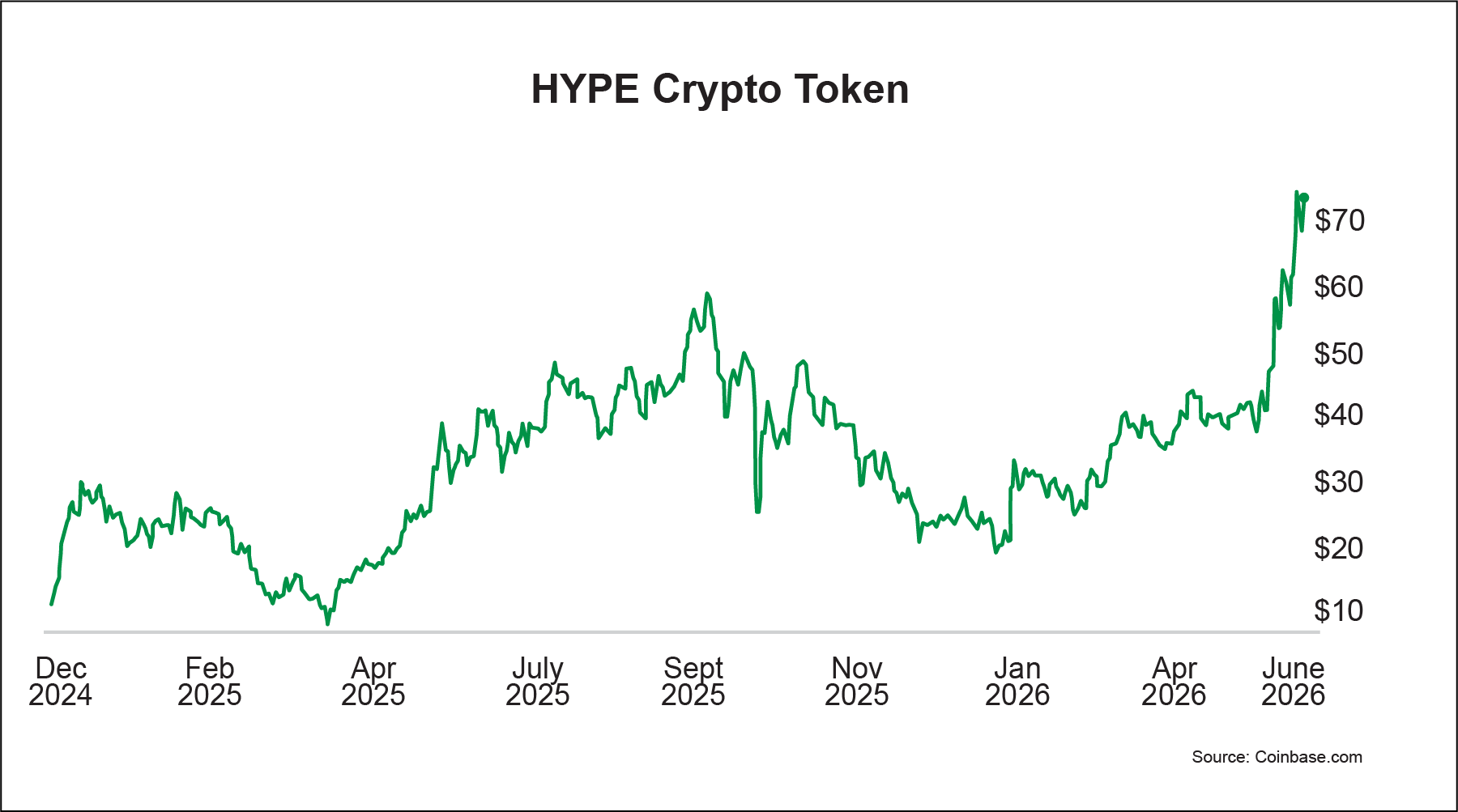
The rise of HYPE.
You don’t just have to take my word for it.
How about the words of Jeffrey Sprecher, the founder and CEO of Intercontinental Exchange, the company that owns the New York Stock Exchange.
Just two weeks after Hyperliquid listed SpaceX, Sprecher sat down for a fireside chat at a Bernstein investment conference in late May and said something that would have been unimaginable 18 months ago: “This Hyperliquid that we’re talking [about], if you haven’t heard about it, it’s bigger than Nasdaq, OK? It’s 11 people. You look at it, you’re like, wow…”
The CEO of the NYSE’s parent company called an 11-person offshore crypto exchange bigger than Nasdaq.
Sprecher noted as well that Intercontinental Exchange has held multiple meetings with Hyperliquid, marking a notable pivot—from an industry that spent years dismissing decentralized finance (DeFi) as a fringe experiment to one that is now scrambling to understand whether its own business model has been structurally disrupted.
That’s not hyperbole.
That’s the CEO of one of the most powerful exchange operators on the planet acknowledging, in public, that a startup with 11 core developers has built something that his billion-dollar organization cannot ignore.
Strip away the crypto vocabulary and Hyperliquid is straightforward: it’s an exchange.
Specifically, it’s a “decentralized perpetual futures exchange.” That’s a lot of words that 99% of Americans have never strung together in that order. So it’s understandable if the term is gibberish to your ears.
Here’s what it means: Traders can hop onto a website called Trade.xyz, bet on the price of almost any asset going up or down, with leverage, without ever taking delivery of the underlying asset.
As for the “perpetual” part… traditional futures on Wall Street all have an expiration date. Perpetual futures in the crypto world have no expiration date. As such, perpetual futures are the dominant instrument in crypto trading globally. For years, they were the exclusive domain of centralized exchanges such as Binance, OKX, and Bybit.
Hyperliquid changed the game by building a different architecture.
Most perpetual exchanges are built on borrowed infrastructure—they run on existing blockchains, such as Ethereum, that were not designed for the high-speed trading necessary for perpetuals. That creates delays, congestion, and increased costs.
Hyperliquid built its own blockchain from scratch—a so-called layer-1 blockchain—engineered specifically for one purpose: trading. When you’re trading perpetuals with leverage, milliseconds matter. They can determine whether you make money or lose it.
“Centralized-exchange speed with transparent, verifiable, self-custodied settlement—and safer.”
The result is execution speed that matches the fastest centralized exchanges—think: Coinbase or Binance—but with one critical difference. On those platforms, your money sits in their wallet, not yours.
On Hyperliquid, your assets stay in your own wallet until the moment a trade executes. Nobody is holding your money. That combination—centralized-exchange speed with transparent, verifiable, self-custodied settlement—makes Hyperliquid structurally different from everything that came before it.
And safer.
When FTX, BlockFi, and others collapsed in recent years, investors were slammed because their crypto was held in pooled accounts on those sites, not in each investor’s individual wallet. So, they lost access to their funds and ultimately recouped only a fraction of their original investment.
With Hyperliquid, your funds are in your wallet, meaning that if a collapse were to happen, your assets aren’t frozen.
The market has noticed Hyperliquid’s advantages.
By April 2026, Hyperliquid held over 70% market share of perpetual volume on decentralized exchanges, known as DEXs.
(Centralized exchanges like Coinbase are centrally controlled, corporate organizations. DEXs are peer-to-peer marketplaces where transactions occur directly between crypto traders.)
HYPE has been processing roughly $22 billion in a 24-hour trading period, and open interest (contracts that investors have opened on the exchange) is near $7.3 billion. Between August 2025 and January 2026 alone, it processed $1.6 trillion in total trading volume, surpassing major centralized perpetual exchanges including Coinbase, Crypto.com, and HTX. The second-ranked decentralized competitor, dYdX, operates at roughly 10% of Hyperliquid’s monthly volume. Clearly, this is not a competitive market. It’s a market dominated by a platform designed by 11 developers that has caught the attention of the New York Stock Exchange.
Hyperliquid’s revenue stream is running at roughly $1.3 billion annualized as of mid-2026, regularly beating Ethereum and Solana on weekly fee generation.
That’s real revenue from real transactions—not subsidized by token issuance, not funded by venture capital, not dependent on speculative activity that evaporates in a bear market.
When traders use the platform, they pay fees. So, the fees are authentic revenue.
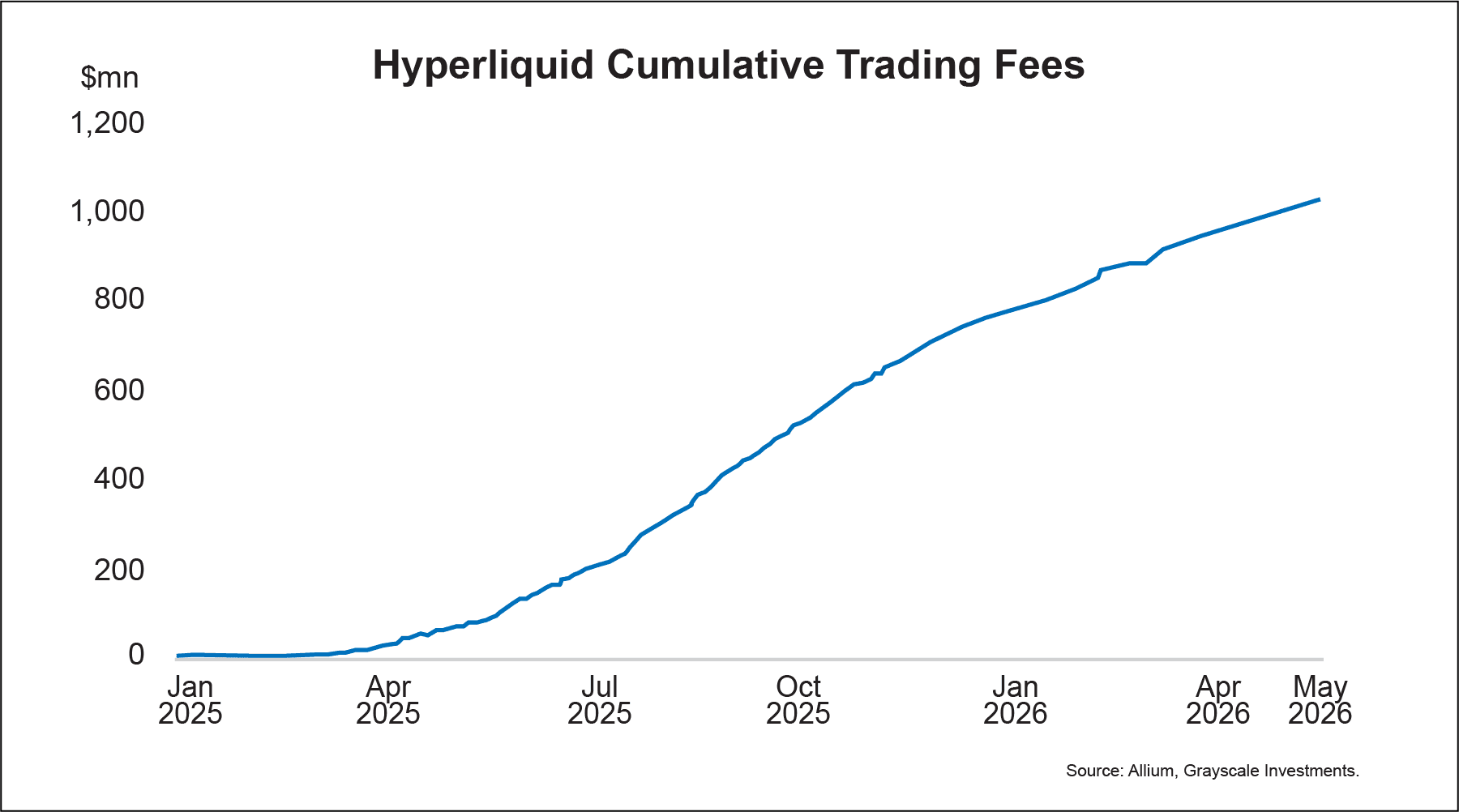
Hyperliquid’s fee machine: cumulative trading fees have climbed past $1 billion.
Here’s where those revenues help us as HYPE coin holders.
Every trade on Hyperliquid generates a small fee—the platform’s equivalent of a commission. Ninety-seven cents of every dollar in fees then flows automatically into something called the Assistance Fund. That fund, in turn, uses that money to buy HYPE tokens on the open market and permanently destroy them, shrinking the total supply every single day.
So that $1.3 billion I mentioned above went to buy-and-burn a ton of HYPE tokens. This isn’t a promise or a policy that management can reverse—it’s written into the HYPE code and executes automatically, whether anyone is watching or not.
The practical effect is straightforward: Every trade on the platform creates mechanical demand for HYPE tokens which are then destroyed, boosting the value of the remaining tokens. The Wall Street analog is a stock buy-back program in which companies use some of their profits to buy back shares on the open market and retire them. The only difference is that with HYPE, the buy-and-burn mechanism operates 24 hours a day and nobody can turn it off.
Why this matters to our investment thesis: Most crypto tokens are dilutive over time, meaning that issuance of new tokens outpaces demand.
HYPE is structurally the opposite. The tokenomics create a beneficial flywheel effect: higher volume funds larger buybacks, which reduce supply, which supports the price, which attracts more users and volume.
There is another detail about Hyperliquid’s founding that matters enormously and gets almost no coverage in mainstream financial media, because mainstream financial media doesn’t find it interesting.
In November 2024, Hyperliquid conducted one of the most significant token distributions in crypto history, airdropping 310 million HYPE tokens—31% of the total supply—directly to nearly 100,000 users who had traded on the platform before the token launched. Some of those wallets received tokens worth six figures… for free, simply because they’d used the platform.
Hyperliquid raised exactly zero dollars from venture capital investors, meaning there was never any VC unlock schedules hanging over the token—no dates when institutional investors who got in at a fraction of the public price had a chance to dump their positions onto retail buyers, destroying the token’s price. That has been too common in crypto over the years. But it was never an issue with HYPE because HYPE never approached VC firms for early funding.
So we don’t face an unlock in the future that promises to gut the token price.
Let’s go back to May 18 so I can explain why the SpaceX perpetuals matter beyond the initial spectacle.
In October 2025, Hyperliquid launched something known as HIP-3—an upgrade to the protocol that runs the Hyperliquid platform. The upgrade transformed the platform into an open financial infrastructure.
Basically, HIP-3 enabled anyone to create permissionless perpetual futures markets by staking HYPE tokens, and then allowing price discovery on assets that traditional markets cannot or will not touch.
That’s where the SpaceX contract emerged. It took shape on a third party called Trade.xyz that is using Hyperliquid’s open infrastructure layer. Hyperliquid simply provided the rails for the Trade.xyz platform that gave rise to an investment opportunity that should not have existed—the ability to trade SpaceX before SpaceX was tradeable on the New York Stock Exchange.
Think about what that means at scale: Anyone can now build a market for any asset because of HIP-3. In turn, every new market created using HIP-3 generates fees that flow back to HYPE and its buy-and-burn mechanism. Every new asset class—oil, gold, equity indices, pre-IPO companies, real-world assets, etc.—that finds its way onto Hyperliquid expands the fee base and accelerates the HYPE flywheel.
Intercontinental Exchange’s Sprecher specifically cited Hyperliquid’s market for weekend oil trading as the catalyst that forced his company to take notice of what was happening on the blockchain with an asset that, to that point, had been a traditional Wall Street offering.
Weekend trading activity in HYPE’s oil market has been especially noteworthy in the wake of Trump’s Persian misadventure. While traditional oil markets are closed on the weekend, traders have been extremely active trading oil on Hyperliquid on Saturdays and Sundays, often tied to Trump’s weekend Truth Social pronouncements about peace negotiations, ceasefires, new attacks despite negotiations, etc.
Price action on Hyperliquid’s primary site, app.hyperliquid.xyz, as well as on Trade.xyz has very often defined where oil prices officially open on the futures market on Monday morning… or at the very least has been directionally accurate, even if the market price on Hyperliquid is more aggressive than on the official futures market.
Sprecher noted that oil markets are seeing significant activity on weekends when geopolitical developments occur, and that Hyperliquid is capturing that volume while traditional markets are sidelined by weekend inactivity. That has prompted Intercontinental Exchange to extend its own trading hours, meaning that the largest traditional exchange operator in the world changed its market hours in direct response to a DeFi protocol built by 11 dudes with blockchain programming knowledge.
That is not a minor event.
That is the moment the disruption became undeniable.
And inevitable.
Which is exactly why I want HYPE in our portfolio.
The platform is generating real revenue at scale. It is structurally deflationary, with 97% of fees funding automated buybacks that have already removed over $1.3 billion worth of tokens from circulation.
The token has no VC overhang and there are now exchange traded funds on Wall Street that allow institutional investors to own HYPE by way of an asset that’s easily traded through traditional channels; that option didn’t exist six months ago. (Financial giant Grayscale is reportedly in negotiations to seed a Hyperliquid investment product at approximately $115 million.)
And we have the CEO of the NYSE’s parent company publicly acknowledging just a few weeks ago that Hyperliquid is the real deal and bigger than Nasdaq by trading volume… and that his company has met with Hyperliquid’s founders multiple times.
We also have a bigger trend on Wall Street now at play: Numerous financial giants including Fidelity, JP Morgan, Goldman Sachs and others are all talking about trading stocks, bonds, commodities, currencies, even real estate and other real-world assets on the blockchain 24/7. Hyperliquid points the way to what’s coming. Not all of that trading will migrate to HYPE, of course, but it doesn’t have to. The platform is already massively profitable and it will see its fair share of assets end up there… which will drive revenue higher, leading to a greater number of burned tokens… helping drive the token price higher over time.
HYPE is not a stock, it’s a cryptocurrency. But there are two ways to trade this—in the crypto market as individual tokens, or on Wall Street as an ETF.
There are some differences…
If you buy HYPE directly as tokens to hold in your crypto wallet, you will do that at Coinbase or Kraken. Both are traditional centralized crypto exchanges. The ticker symbol you will look for is HYPE. (If you need a refresher on setting up a Coinbase account and buying crypto there, you’ll find that in my Crypto Strategy Report starting on page 16.)
This is the way I would tell you to own HYPE if you are comfortable trading crypto.
Moreover, I would tell you that once you own HYPE in your exchange account, you should move the tokens to a browser wallet like Metamask or a cold wallet like a Ledger. (You’ll find a guide to wallets starting on page 16 of your Crypto Strategy Report.) That way, you own your tokens outright. If your chosen exchange were to collapse for whatever reason, your tokens are safe in a wallet that only you control.
In addition to simply owning tokens, you’ll want to stake them. “Staking” essentially means putting your crypto to work so it can earn you more crypto. It’s like putting your tokens on deposit. When you stake, not only will you benefit from a token’s rise in price, you’ll see the number of HYPE tokens you own increase over time.
Once you have HYPE in your personal wallet, head to app.hyperliquid.xyz and look for the “staking” option in the menu at the top of the screen. Click there and follow the prompts to stake your tokens. In terms of which validator option to choose, Hyperliquid itself recommends “Nansen x Hypurrcollective,” so I’d go with that one.
If you buy Hyperliquid as an ETF, then the one you want trades under the symbol BHYP—the Bitwise Hyperliquid ETF, which launched in May. It imposes an annual management fee of 0.34%.
BHYP stands apart because Bitwise has an in-house staking mechanism, so you will not only see the benefits of a rising token price, but you’ll see the number of HYPE tokens you own increase over time because of the staking.
You will be able to trade BHYP at traditional brokerage firms such as Fidelity and Schwab, as well as phone-based trading apps such as Webull.
If you want to own HYPE inside an IRA, then the ETF option is your best bet, unless you own a self-directed IRA that allows crypto trading.
I’ve given HYPE my highest-risk rating for obvious reasons: It’s crypto, and crypto can be crazy volatile. So I will tell you not to own this one if crazy volatility scares you. This is simply not the investment you want to own.
But if you’re OK with crazy volatility, then HYPE stands apart as one of the cryptos that is going to very likely redefine traditional finance. Personally, I want to be a part of that, which is why I own some HYPE in my Metamask browser wallet.
I don’t see HYPE as a trade, meaning I’m not necessarily looking for a short-term gain.
This an infrastructure play on the most consequential shift in financial market structure in a generation—the migration of traditional-market trading from closed, permissioned, 9-to-5 incumbent exchanges to open, transparent, 24/7 on-chain infrastructure.
That migration is already happening and Hyperliquid is the dominant platform facilitating it.
As I noted earlier in this issue, HYPE is trading near all-time highs. So I would not be surprised by a pullback at some point. If we get that, I would use that as an opportunity to deepen your exposure.
So don’t put your entire allocation into HYPE immediately. Buy some now to establish a position, and then buy some later on a pullback under $65.
I don’t want to leave you with the impression that the future is all rainbows and roses. Hyperliquid does have issues you need to know about to make an informed investment decision.
In March 2025, a sophisticated trader manipulated the JELLYJELLY crypto token on Hyperliquid, engineering a position that threatened the platform’s liquidity vault with a loss exceeding $700,000.
To address the problem, validators (the people running the computers that house the HYPE blockchain globally) voted to delist JELLYJELLY and to settle positions at their preferred price—unilaterally and off-chain (i.e. not on the main Hyperliquid blockchain). Bitget CEO Gracy Chen called it “immature, unethical, and unprofessional.” Total value locked (TVL) in the platform’s vault dropped from $540 million to $150 million in the weeks that followed as HYPE investors voted with their feet to leave.
Hyperliquid responded with governance reforms and moving validator voting on-chain. The platform recovered, and TVL and trading volume subsequently reached new records. But the episode confirmed something that the decentralization narrative tends to obscure: a small validator quorum can intervene in markets with other people’s money in an instant. That is not what most users think they’re signing up for when they trade on a “decentralized” exchange, which is not supposed to have centralized control.
Under US law, the perpetual futures on Hyperliquid are treated as swaps under the Dodd-Frank Act, which brings strict rules around reporting and risk control.
Intercontinental Exchange follows these rules.
Hyperliquid, operating offshore, does not.
Jeff Sprecher has publicly called for policymakers to resolve the gap.
The two scenarios Sprecher outlined—a new regulatory category for on-chain perpetuals, or full application of existing Dodd-Frank frameworks—have very different implications. The first could open US markets to Hyperliquid for the first time. The second could force it to either register as a swap execution facility at an enormous cost and compliance burden, or exit the US and EU retail markets entirely.
My bet is that Congress chooses Option A, since the US is aggressively trying to emerge as the crypto capital of the world.
That is a significant exclusion—the world’s deepest capital market.
But there’s also a huge upside here.
If regulatory resolution goes in the right direction, it’s transformative in the most bullish of ways for Hyperliquid.
Blockchain analytics confirmed North Korean state-sponsored addresses were actively trading on Hyperliquid in late 2024 and early 2025, losing over $458,000 in what security researchers described as likely reconnaissance to probe system vulnerabilities.
Hyperliquid reported that no vulnerabilities were identified or exploited. Still, you have to know the risk exists.
But because Hyperliquid knows the risk exists, it’s able to strengthen the systems to prevent a hack.
Ultimately, here’s where I land on Hyperliquid:
Jeff Sprecher said that he wishes he were young again so that he could be building what Hyperliquid has built. To me, that says something exceptionally bullish when it’s coming from the head of the company that owns the New York Stock Exchange.
I can’t build what HYPE is building either.
But I can own a piece of it and benefit from what’s to come.
This month’s portfolio review is about Intel.
We’re now up nearly 450% on the iconic computer-chip maker since adding it to our portfolio as an AI play in March 2025.
So, first and foremost, let’s sell one-half of our position and lock in a huge gain that recoups all our initial investment plus nearly 2x more.
The price as I write this is bouncing around $114.
That done, let’s back up and look at what happened to drive Intel shares so dramatically in the time we’ve owned them. It shows the potential when you invest opportunistically in great companies that have been temporarily beaten down. That’s one of the themes I’ve long used a mile marker in my personal investing.
As I wrote in that March 2025 issue, “Intel screwed up” because it “fumbled the AI opportunity.”
From that issue:
The company at one point thought about buying Nvidia, the maker of GPUs—the graphics processing units that turn digital data into visuals on your computer screen.
But Intel execs saw Nvidia as a niche player catering to gamers who need fast computational power for their video games, and for crypto miners who emerged over the last decade as big buyers of GPUs for the crypto mining rigs they were building, which also demanded extremely fast number-crunching capabilities.
Intel stepped away from that idea and pursued what would turn out to be a failed effort at building an AI chip.
Ultimately, Nvidia pulled ahead as the go-to source for AI computing power because its chips were so fast.
Nvidia went on to dominate the AI space, while Intel slipped ever closer toward oblivion.
But the very month we bought into Intel, the company changed its CEO, hiring Lip-Bu Tan, a veteran semiconductor investor who had served on Intel’s board. And that changed everything.
Tan worked with partners to improve chip yields, which helped launch the Panther Lake AI PC processor chips that are doing well. As I wrote in the original recommendation, I was convinced that the emergence of China’s DeepSeek AI as a different kind of competitor to ChatGPT was going to open a lot of eyes that would then focus on Intel.
DeepSeek was the wake-up call that changed how the tech world thinks about AI.
Before DeepSeek arrived in early 2025, the conventional wisdom was that serious AI required massive, expensive GPU farms—the kind of industrial-scale infrastructure that only hyperscalers like Microsoft, Google, and Amazon could afford to build and run.
DeepSeek blew that up by building an AI model that proved you could get world-class AI results without drowning in GPU horsepower.
The implication of that was seismic: if AI models can be made that efficient, they don’t need to live in a data center. They can live on a computer processor, the chip that runs your laptop and desktop… which is exactly where Intel’s Panther Lake stepped up to prove my point that Intel was going to re-emerge as an AI winner.
Panther Lake can run large language models (LLMs) with up to 70 billion parameters locally, without touching the cloud or offloading the request to GPUs. Previous generations of Intel laptop chips could only handle models a fraction of that size.
So, what DeepSeek proved—that powerful AI doesn’t require a server farm—Panther Lake brought to life. Instead of your AI assistant routing your question to a data center in Virginia or wherever and billing someone by the query, Intel put all of that artificial intelligence capacity on the chip sitting inside your desktop, running faster, running privately, and running for free after the one-time hardware purchase.
Intel essentially built the chip for the world that DeepSeek described.
Which is what I saw coming, and why I looked at Intel in March 2025 and didn’t see a once-famous brand in its death throes… but rather a tech giant that made a mistake and which had a new lease on life because of what DeepSeek proved.
Intel was never going to be Nvidia, but then again Nvidia was never going to become the Intel Inside CPUs. And with AI moving to the desktop after years of confinement to the GPU, well, that was always going to be an Intel story.
Which is why you’re reading this and now looking at big gains.
The next event I am watching with Intel: the move to 14A, Intel’s next-generation manufacturing process. This refers to 14 angstroms, which is roughly 1.4 nanometers, or about 10,000 times thinner than a human hair. Intel and Taiwan Semiconductor are in an arms race to produce 1.4 nanometer chips.
Early design commitments for Intel’s 14A are expected to emerge beginning in the back half of the year, and expand into the first half of 2027. Every named customer that signs on gets announced—and each one is a re-rating event.
The list of companies actively kicking the tires includes Google, Apple, AMD, and Nvidia. Any formal announcement from that group—particularly Apple—will very likely send Intel shares meaningfully higher, because it validates Intel’s foundry business in a way that no amount of management commentary can.
So, we lock in big gains… and now we hold free shares that could dump much more money into our pockets over the next year.
Here’s to living richer,

Jeff D. Opdyke
Editor, Global Intelligence Letter
P.S. The world is changing faster than most investors realize. Debt is exploding. The dollar’s long-held dominance is being challenged. Artificial intelligence is reshaping industries overnight. And geopolitical fault lines are creating risks—and opportunities—that simply didn’t exist a decade ago.
That’s why I’m hosting my second annual Future of Wealth Summit in Dublin, Ireland this fall.
At this special event, you'll hear from leading analysts, investors, and entrepreneurs who are tracking the trends that could define the next decade of wealth creation. More importantly, you'll learn practical strategies to help protect your purchasing power, preserve your capital, and position yourself for what's coming next.
You can read the full details here… including why I believe November 3, 2026 is the key date that could kick off the next American crisis—ultimately setting the stage for what could be some of the greatest wealth-creation opportunities in history.
The biggest financial shifts rarely announce themselves in advance. By the time they become obvious, the best opportunities are often gone.
© Copyright 2026. All Rights Reserved. Reproduction, copying, or redistribution (electronic or otherwise, including online) is strictly prohibited without the express written permission of Global Intelligence, Woodlock House, Carrick Road, Portlaw, Co. Waterford, Ireland. Global Intelligence Letter is published monthly. Copies of this e-newsletter are furnished directly by subscription only. Annual subscription is $149. To place an order or make an inquiry, visit https://internationalliving.com/page/faq/. Global Intelligence Letter presents information and research believed to be reliable, but its accuracy cannot be guaranteed. There may be dangers associated with international travel and investment, and readers should investigate any opportunity fully before committing to it. Nothing in this e-newsletter should be considered personalized advice, and no communication by our employees to you should be deemed as personalized financial or investment advice, or personalized advice of any kind. We allow the editors of our publications to recommend securities that they own themselves. However, our policy prohibits editors from exiting a personal trade while the recommendation to subscribers is open. In no circumstance may an editor sell a security before our subscribers have a fair opportunity to exit. The length of time an editor must wait after subscribers have been advised to exit a play depends on the type of publication. All other employees and agents must wait 24 hours after on-line publication prior to following an initial recommendation. Any investments recommended in this letter should be made only after consulting with your investment adviser and only after reviewing the prospectus or financial statements of the company.