Dear Global Intelligence Letter Subscriber,
On an undisclosed island, in an undisclosed location, the future is afoot.
A technology company has produced hundreds of thousands of high-powered, unthinking laborers—aka, robots. Some are skilled. Some not. Either way, these robots, fashioned from synthesized living tissue, are the future of work for the companies they’re headed to in Southampton, England; New York; Hamburg, Germany… and beyond.
There is, however, a fly in this ointment. Rather, a human in the ointment.
A woman named Helena Glory, president of the Humanitarian League. True to her humanitarian philosophy, she pushed developers to refashion the worker bots so that they have something resembling human traits, particularly the ability to think independently as a means for more efficient work.
As with all good intentions, however, this one paved a road to hell… because the result was not what Helena or the designers expected.
The quasi-humanized bots quickly coalesced around ringleaders who then started a revolt… which led to the death of everyone except the company’s founder.
Ah, the joys of technology run amok.
Now granted, you’ve not likely heard this news anywhere in the Western press.
Because it was never news.
It was a play, Rossum’s Universal Robots, written by a Czech playwright, Karel Čapek.
And it was written more than a century ago, in 1920.

Robots on the rampage in Čapek’s play… (Source: websites.umich.edu)
Čapek’s play is widely regarded as the first known instance of the word “robot” appearing in any written text anywhere in the world. In fact, the word “robot” is simply a slightly shortened form of a Czech word, “robota,” which translates as something like “servitude” or “forced labor.”
It was the first time society confronted the notion that technology might one day replicate humans.
Said another way: That was the moment “artificial intelligence” became a thing.
We start with that hundred-year-old drama for this month’s issue of Global Intelligence because it directly plays into one of the hottest topics of the day: The arrival of the DeepSeek artificial intelligence engine in January, a Chinese AI bot that wrought havoc in financial and crypto markets around the world.
Until DeepSeek appeared, investors were focused on ChatGPT and other AI engines that have been wowing humanity by tapping into the processing power of hugely expensive Nvidia computer chips. Those chips were originally designed to power computer graphics cards. But techies usurped them for AI needs because processing graphics is so data intensive that GPU (graphics processing unit) chips have emerged as some of the most powerful chips in the world. Meaning they’re great for AI’s unquenchable hunger for data mining and processing.
DeepSeek, however, showed that superior performance can come at sharply reduced costs. And that revelation freaked out the world. The tech-heavy Nasdaq stocks fell 3% the day DeepSeek appeared, led lower by Nvidia plunging 17%.
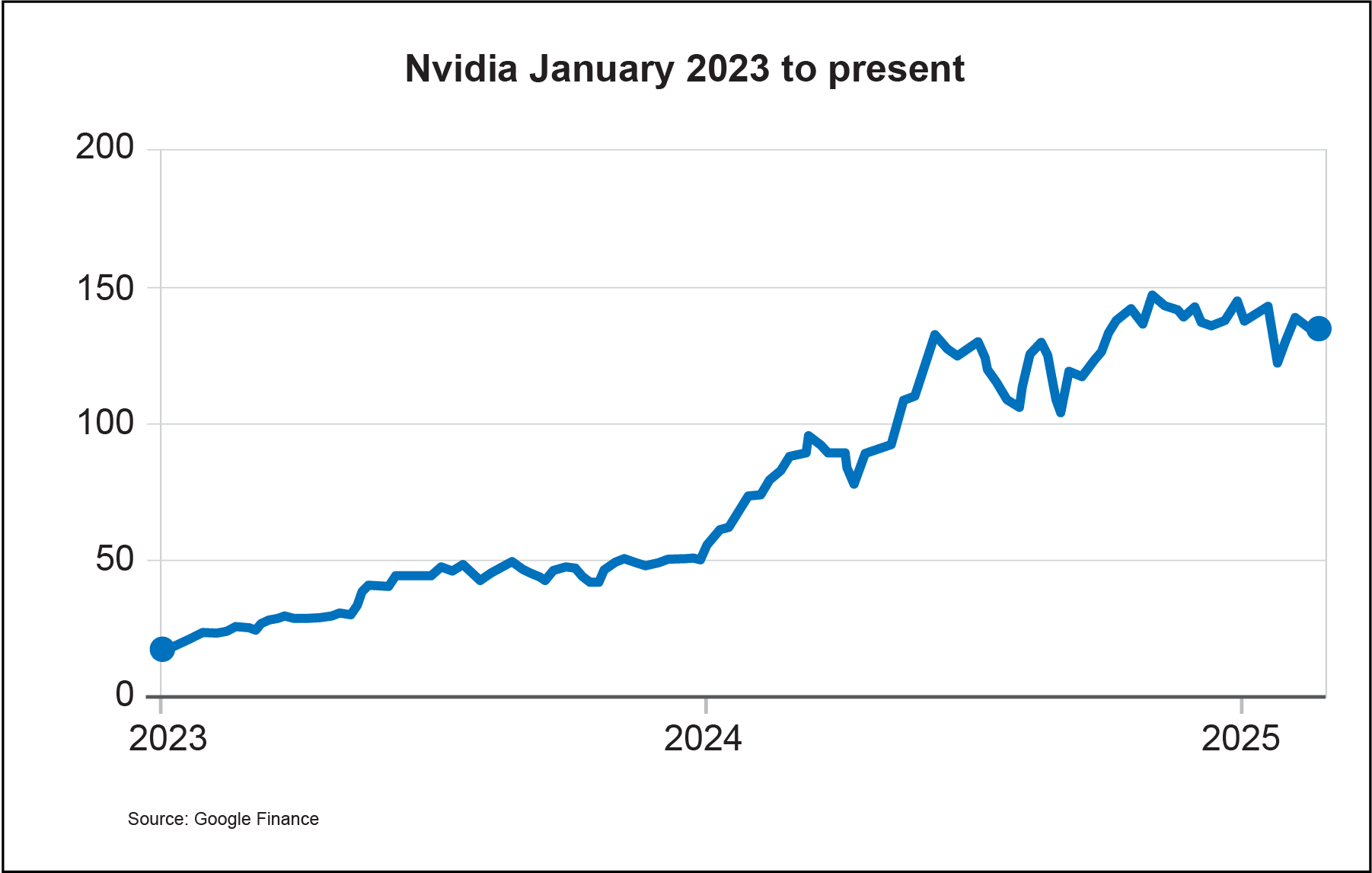
Nvidia had an extraordinary 10x price run from January 2023 to late 2024. The shares have fallen off a bit in 2025—and another 10x run is not likely anytime soon.
I will tell you now that we are not investing in Nvidia this month.
Despite the decline, the shares are still not very cheap. In fact, they’re quite pricey.
That said, we are going into AI this month.
But we’re doing so by way of what I call the Blue Plate Special of Investing.
In other words, we’re grabbing AI on the cheap.
Though the idea of artificial intelligence has been around for more than a century, as demonstrated by that long-forgotten Czech play, the public’s general perception of AI is about 15 years old at best. You might recall that IBM’s “Watson” famously used “natural language processing” to defeat two Jeopardy! champions.
But even that doesn’t really define what most of us consider to be AI.
For us, AI really begins in November 2022, with the arrival of ChatGPT—a so-called “large language model,” or LLM, that can quickly process our requests and spit out human-like content.
Suddenly, we humans saw what AI can do in our life… and more darkly, to our life (more on that later).
I mean, it’s one thing for Watson to beat Ken Jennings on a television quiz show. That has no impact on our daily living beyond water-cooler chit-chat.
But it’s something entirely different to log into ChatGPT and ask it to write a 1,000-word essay arguing against “Gordon Wood’s idea of a pre-Revolutionary utopia and the capital-forming effects of military mobilization.” (That’s a thing, actually: I picked it because I recently rewatched one of the best movies ever, Good Will Hunting.)
Scroll through Twitter/X or YouTube, or TikTok or Instagram, and you’ll come across an innumerable quantity of written and/or visual content that is either:
In short, AI has ushered in an entirely new age of opportunities to create content that users can sell… or use to pass a Harvard class on Early-American History.
And this is just the beginning of how AI can upend everything from media to education to the c-suite to healthcare….
In the AI arena we clearly have a huge opportunity that has a very long shelf-life.
Which is great for us as investors because some trends on Wall Street disappear as quickly as they appeared.
Back in 2003/04, for instance, the Atkins Diet fad ripped through the Street. Meat was good; bread was bad. And so, companies like meatpacker Hormel Foods and pork producer Smithfield Foods surged… while investors pummeled companies including Krispy Kreme Doughnuts, cereal giant General Mills, and fast-food chain Panera Bread Co.
But Atkins faded quickly (no one forsakes doughnuts for long!) and was pretty much dead and buried by 2005 as Wall Street moved on to other short-lived fads like the Street’s fascination with ugly-shoe brand Crocs and then Heelys, the wheeled shoes youngsters loved in 2006/07.
“Most AI stocks are insanely overvalued these days… but the technology itself is here to stay and will only improve.”
Though most AI stocks trade at valuations these days that make insane seem milquetoast (testament to Wall Street’s overhyped expectations), the technology itself is here for the duration and will only improve.
Unlike the Atkins Diet, AI really is the future.
ChatGPT and DeepSeek and all the others are just an amuse bouche—an appetizer hinting at a much bigger banquet to come. That banquet, by way, promises to generate tremendous wealth for those who own the right stocks going forward… and tremendous losses for those who buy into overhyped AI stocks.
In many ways, then, this moment feels a lot like a replay of the original dot-com boom and subsequent bust: Lots of hype for everything and anything related to the internet… followed by a devastating collapse that wiped out trillions of dollars in wealth… followed by the real boom in which the internet proved it wasn’t overblown and, instead, emerged as one of the most important leaps forward in human history.
AI is the same, just magnified.
But how does AI work?
You need to understand that to understand this month’s investment recommendation.
AI relies on vast quantities of data to make better decisions, be that predictions about where bitcoin’s price will be at the end of 2025, based on analyzing a massive array of historical data; or, creating a unique visual image based on a user’s written or verbal input, drawing on an equally massive array of images catalogued to reflect artists, periods, styles, colors, compositions, and what not.
Just for giggles, I asked OpenArt.ai to “reimagine Edward Hopper’s famous “Nighthawks” painting in the pop-art style of David Hockney’s “The Splash.” This what OpenArt generated…

I gotta say, that’s not bad. It feels like Hopper and Hockney tag-teamed on this. The scene reeks of Hopper and his dark, muted tones that speak to a solitary and sometimes lonely America… but then you have the hint of a swimming pool at the bottom, reflective of Hockney’s famous, early-career theme.
The image is based on “unsupervised learning,” or what OpenArt knows about Hopper, Hockney, their works, and pop-art in general, all predicated on the massive quantities of data that were used to train the AI engine.
But maybe this image isn’t quite what I want to convey, so I offer a revised prompt like: “That’s not quite right. The image needs to convey more solitude, and the pool needs to be more prominent” and I get this:

Very similar image, but now the two men aren’t engaged with each other. The door to the house is open, but the interior seems desolate. And the pool is much more prominent.
This is “reinforced learning”—AI learning to be better at its job based on feedback, positive or negative, that it receives from a human user.
The point to all of this is that AI demands access to data flowing in water-hydrant-like torrents to quickly produce and iterate as required.
Not every computer chip is up to that task.
Many are simply much too slow to produce whatever is required in speedy fashion.
Those images each took my computer about eight seconds to generate. With the first one, I told OpenArt to upscale the original image to 4K (because I kind of like it and I might turn it into a poster for my office). That’s heavy computational lifting. The original image is 600 kilobits; the upscaled version is more than 20 megabits—or 33x larger.
The desktop computer I built with high-end components required about 90 seconds to complete the task.
My low-end laptop needed 18 minutes.
The difference: the graphics processor in each computer.
The desktop I built taps into a graphics processing unit, a GPU, with 12 gigabytes of RAM to handle whatever heavy-duty video and AI processing demands I throw at it. My laptop’s GPU has a measly 512 megabytes, about 24x less powerful.
Now, I know that’s boring information. And I assure you we shan’t be revisiting this kind of data anywhere else in this month’s issue. But it’s important to know because the world of AI promises to gobble up more and more—and more and more and more—processing power to complete the increasingly complex tasks that humans will demand of AI as we move forward.
Consider healthcare for a moment. This is how Forbes explained the AI metamorphosis taking place right now across that industry:
AI is transforming everything from diagnostics to patient care, creating a system that is faster, more accurate, and increasingly personalized.
AI-powered tools are already diagnosing diseases with remarkable precision. Algorithms trained on medical imaging datasets can detect conditions like cancer, heart disease, and neurological disorders earlier than human practitioners. For example, AI models used in radiology are shortening diagnostic timelines, enabling quicker interventions that save lives.
On the operational side, AI is streamlining administrative processes. Tasks such as scheduling, insurance verification, and medical coding are being automated, reducing inefficiencies and allowing healthcare providers to focus on patient care. Predictive analytics is also reshaping public health, identifying patterns to anticipate disease outbreaks and allocate resources more effectively.
Healthcare is just one example. And I’m not going to bog down our narrative with all kinds of anecdotes for different industries. Just apply what’s happening in healthcare to transportation, retail, financial services, entertainment, media… the list just keeps on going.
As I was writing this, the New York Times announced it has approved AI tools that editorial teams will use to expedite tasks such as synthesizing articles into smaller, social media tweets and posts, and for writing headlines that meet search-engine optimization guidelines.
Of course, a distinctly dystopian downside exists with AI. I’m not going to delve into that here. I comment on it from time to time in my Field Notes daily e-letter. But I do want to acknowledge that AI is not all gumdrops and unicorn sneezes. AI is already displacing loads of workers across the pay spectrum. That’s only going to worsen.
“We can be 100% certain that AI is our future because profit-chasing corporations are going to ensure that AI is our future.”
I mean, let’s just go back to healthcare. If AI can scan radiology images and diagnose medical issues faster than humans, doesn’t that bode badly for radiologists over some uncertain period of time?
And what of paralegals and TV script writers and teachers and customer-service reps and accountants and proofreaders and receptionists and telemarketers and graphic artists and on and on…
Again, that’s too much to dive into for an investment recommendation, but I mention it because it plays into the ultimate reason we want to own an AI play: Corporate greed.
AI is about efficiency, and efficiency is about money, and money is about corporate profits… and in the American form of capitalism, “corporate profits” is a religion unto itself.
Fewer workers equals lower labor costs equals fatter corporate profits.
Thus, we can be 100% certain that AI is our future because profit-chasing corporations are going to ensure that AI is our future.
So, we play the game too.
And the game we’re going to play is centered on Intel Corp.
Let me be clear up front: Intel screwed up.
Big time.
At one point, Intel was one of the most powerful names in tech and among the biggest and most well-known brand names in computer hardware. Historically, no one cared what components were hiding inside a computer. All consumers cared about was the brand name on the outside: Dell, Compaq, Hewlitt Packard, whatever.
But then in 1991, “Intel Inside” emerged as a tagline in advertising—a logo that conveyed “quality” to computer buyers who really had no idea about computing beyond gaming, word processing, building a few spreadsheets, and sending emails.
“Intel’s market cap surged from just over $5 billion in 1991 to nearly $275 billion by 2020.”
For the next 30 years, Intel excelled as one of the core drivers of the high-growth market for personal computers.
The company’s market cap—the stock market value of the entire company—surged from just over $5 billion in 1991 to nearly $275 billion in 2020.
Today, Intel is not even at $120 billion.
The culprit: Intel fumbled the AI opportunity.
Intel’s C-suite and designers continued to focus on what made Intel great: building microprocessors, the so-called CPUs (central processing units) that manage a computer’s processes—from running the operating system to processing user inputs to storing data for later retrieval.
As the New York Times reported last year, an “Intel executive only half-jokingly, described the company as ‘the largest single-cell organism on the planet,’ an insular self-contained world.”
The company at one point thought about buying Nvidia, the maker of those GPUs I mentioned earlier—the graphics processing units that turn digital data into visuals on your computer screen.
But Intel execs saw Nvidia as a niche player catering to gamers who need fast computational power for their video games, and for crypto miners who emerged over the last decade as big buyers of GPUs for the crypto mining rigs they were building, which also demanded extremely fast number-crunching capabilities.
Intel stepped away from that idea and pursued what would turn out to be a failed effort at building an AI chip.
Ultimately, Nvidia pulled ahead as the go-to source for AI computing power because its chips were so fast.
Which brings us to today and DeepSeek’s impact on the technology…
DeepSeek might just be the best thing to happen to Intel in years because of the ways that DeepSeek rejiggers the AI marketplace.
In the time since ChatGPT emerged, the AI space has been focused on what’s known as “generative AI,” a version of AI in which AI models use the data they’re trained on to then “generate” text, images, videos, and such based on natural language inputs from users… basically what I did when I told OpenArt.ai to reimagine Edward Hopper’s “Nighthawks” in a David Hockney style.
Generative AI relies almost exclusively on GPUs because of their speed. That has benefited Nvidia at the expense of Intel because companies have shoveled so much money at snapping up as many of the latest/greatest Nvidia GPU cards that they can find.
In that process, they have largely sidelined traditional computer hardware like CPUs, the brains of any computer.
DeepSeek, however, has shown that intense GPU processing speeds are not always necessary. The DeepSeek model optimizes software over hardware, meaning AI needs fewer GPUs.
As one summary comparing DeepSeek to ChatGPT and others, suggests:
“DeepSeek took a different approach. Instead of relying on expensive high-end chips, they optimized for efficiency, proving that powerful AI can be built through smarter software and hardware optimization… the company optimized its model to run on lower-end hardware without sacrificing performance.”
I have no idea how accurate this claim is, but DeepSeek says it spent just $5.5 million to train its V3 model. OpenAI, the company behind ChatGPT and OpenArt, reportedly spent hundreds of millions. That, by the way, is what freaked out Wall Street when DeepSeek launched. The cost differences, if accurate, would have profound implications on Nvidia and others in the GPU business, which is why Nvidia stock fell so sharply.
And why Intel’s shares didn’t.
DeepSeek’s AI model is “open source,” meaning anyone can download it, use it, change it, and redistribute it. That, along with the vast cost savings, will very likely see a rash of tech companies rush to adopt the DeepSeek approach to AI, which would reduce demand for GPUs and refocus demand on software-based processes—a CPU specialty.
Which is an Intel specialty, given that Intel controls about 60% of the CPU market.
Intel’s latest chips—Sierra Forest and Granite Rapids—are designed for high-performance computing, and they’ve been receiving plaudits from the tech community. Moreover, Intel is now expanding in the AI processor arena with its Gaudi 2 and upcoming Gaudi 3 AI accelerator chips, which are also picking up good reviews.
If we begin to see AI migrate away from near-total reliance on GPUs and toward software-based processes, Intel’s new chips are going to see ramping demand.
Moreover, DeepSeek released a smaller version of its full-scale AI model because the company realized that not every AI user needs to run a model that takes into account 671 billion parameters. Some of us have much lighter demands.
That more-compact version of DeepSeek will quite likely appeal to end users like consumers and businesses that are focused on highly specific AI modeling needs in specialty areas like, say, healthcare services or even my own efforts at creating an AI model trained on the last decade or so of my writing.
I don’t need a full-scale version of AI when a much more power-efficient version would address my demands. Nor do healthcare companies, or financial-services companies modeling investment portfolios, or retailers modeling consumer behavior.
Those demands jibe well with far-less-costly CPU-based processing.
All of which means Intel at today’s prices represents a very cheap way to play the next phase of the transformative AI revolution.
Intel shares trade in New York, so you will have no problem buying the shares through any US brokerage firm, including web-based firms such as Robinhood and Webull.
As I write this, the shares trade at just over $25 per share, and they yield a relatively small dividend of just over 1.9%.
Because of the stock’s fall to the mid-$20s from nearly $70 back in April 2021, Intel has de-risked itself. Investors got out because they no longer saw big returns with Intel… but I’ve made the case for why that could now turn around.
Still, I’m giving this stock a high-risk rating for a few reasons:
Right now, tech stocks as a sector are overvalued because so much money has flooded into the sector in recent years.
That doesn’t mean, however, that Intel is overvalued. It just means that because the sector as a whole is overvalued, if investors bail on tech shares for whatever reason, Intel would feel it to some degree.
I suspect the pain that Intel might feel in that moment would be substantially less, as witnessed by the DeepSeek disruption. After DeepSeek launched, Nvidia fell by nearly 17%, but Intel lost only about 2.5%.
Intel management has already demonstrated poor judgment in mismanaging the AI boom. I don’t think that will happen again, but I have to list this as a risk just so that you know it exists.
US stocks are substantially overvalued these days. If the market as a whole takes a sharp tumble for whatever reason, Intel would probably be in the mix because it’s a such a widely held stock, and widely held stocks are the ones that investors tend to sell in order to build cash reserves.
That said, Intel would likely not face the same kind of selling pressure because, again, the shares have de-risked by a large degree over the last few years.
In short, Intel has risks just like every other tech stock on Wall Street, but I think those risks are not as large as they are with other tech giants like Nvidia, Tesla, Apple, Microsoft, et al.
My expectation is that we're going see Intel's shares push back toward their highs in the $60 range, which is where the stock traded in 2021.
I truly believe that AI is increasingly going to exploit far more cost-effective CPU power, and Intel is going to be a prime beneficiary of that.
Intel is, as I wrote at the outset, a Blue Plate Special AI play right now.
To be sure, Intel screwed up its approach to AI, but because of the arrival of DeepSeek, the AI space is now shape-shifting into something different than it has been over the last few years.
And in that shift, Intel could be one of the biggest winners.
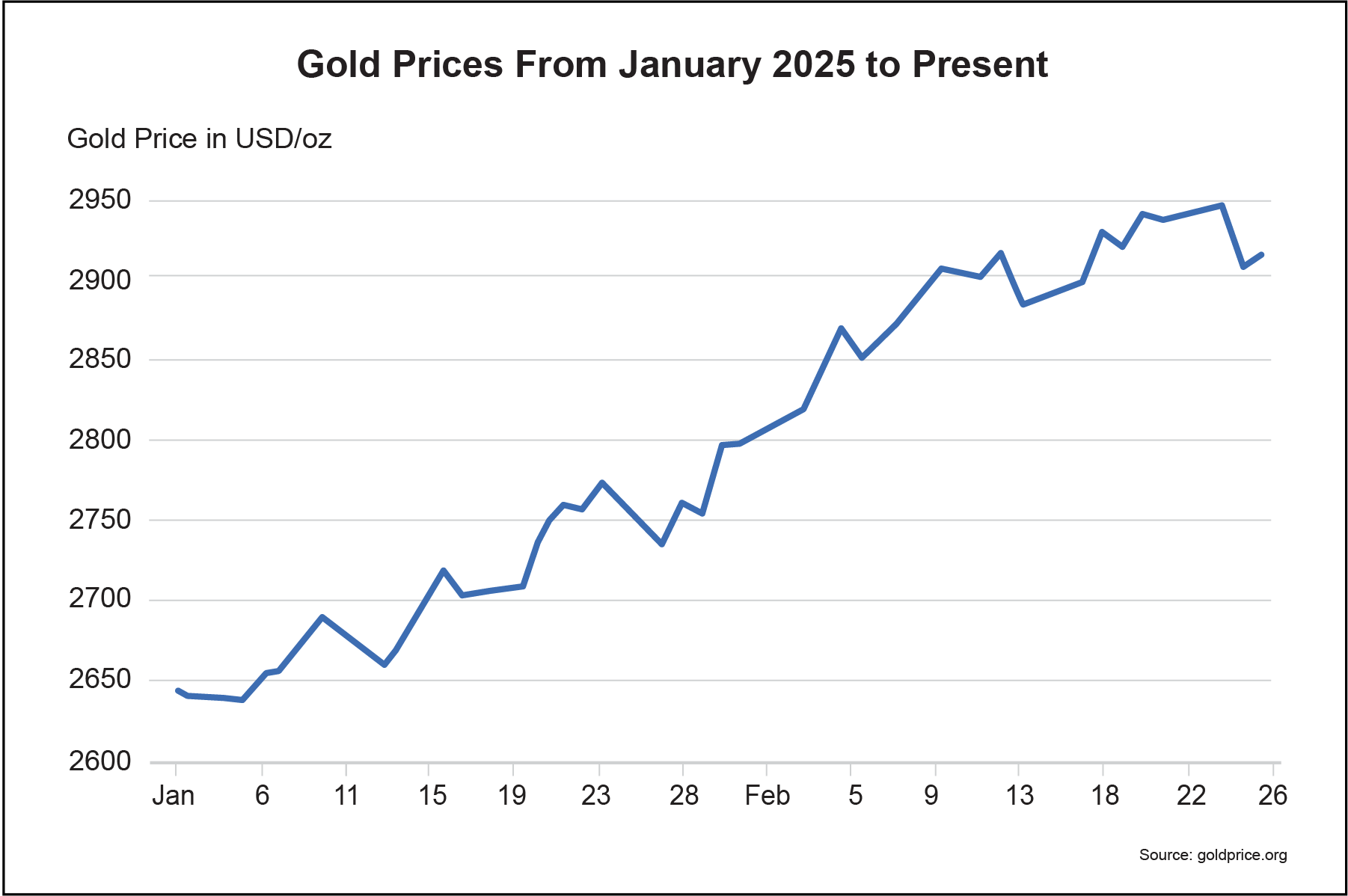
Gold has gained around 14% so far in 2025…
We have to talk about gold in this month’s Portfolio Review.
You might recall that back in the last issue of Global Intel, I called 2025 the Year of Gold. But honestly, I wasn’t expecting nearly a full year of gains to arrive in a couple of weeks.
The price of gold has surged rapidly and is now butting up against a record $3,000 per ounce. It opened the year at $2,624, so the metal is already up more than 14% in less than two months.
Now, big banks like Goldman Sachs, Bank of America, and others are jumping on the Global Intel bandwagon and calling for gold to cross $3,000 and keep moving higher.
A big part of gold’s sprint so far this year is as a result of tons of the metal relocating to the US from abroad. In fact, a record amount of gold is leaving London, the largest global storage and trading hub. Gold is also fleeing Switzerland and Singapore.
One of the reasons put forward for this is that gold’s price in the US is higher than it is overseas right now by about $20 per ounce. Thus, traders are apparently flying their gold to the US to sell it at higher prices. Basically, global arbitrage.
Maybe that’s true. Though honestly, I don’t know that I buy it. Gold is heavy and shipping costs would eat into that $20-per-ounce margin. But maybe there’s still money in that—I don’t know.
I suspect there’s a darker reason for this “gold migration”…
A growing chorus of voices—starting with President Trump and Elon Musk—are calling for an audit of America’s gold, supposedly held in Fort Knox.
I say “supposedly” because for decades rumors have swirled that Fort Knox is mostly empty—that America has been regularly and routinely selling off its gold over the years, the result being that dust has largely replaced America’s gold.
I have no idea if that’s true.
No one does.
A couple of perfunctory spot examinations of Fort Knox have occurred twice in the last several decades, and usually as more of a photo op to imply, “See? Gold! All good. Now go away!” No one was allowed to assay the bars (they could have been lead spray-painted gold) nor was anyone allowed to record a gold bar’s serial number to check against official records.
The last full audit occurred in the early 1950s, and ever since then the Federal Reserve, which serves as custodian for America’s gold, has ringfenced Fort Knox and blunted any efforts to audit the gold—even when those efforts originated with Congress. That in itself seems quite suspect. I mean, Congress, as the voice of the American people, has the right to audit whatever the hell it wants to audit… but the Fed says no.
Hmmmm…
But now Trump is on the case. And per usual, he bulldozes his way through whatever he wants, and what he wants now is an audit of America’s gold.
Which could explain why bajillions of tons of gold are suddenly heading to the US from all points on the globe.
See, the US has reported 8,133 tons of gold in its vaults for eons. The number never changes. Ever. Seems suspicious.
Years ago—back around 2012 or so—I and a member of my research team at the time pieced together all the gold that flows into and out of the US, and into and out of China. These numbers are reported officially on import/export document that both governments keep and make public.
What we found odd was that far more gold left America in the early 2000s than could be accounted for through mining and recycling and whatnot. Where would gold in that quantity be coming from? Only one source had that much gold to spare… US gold reserves.
At the time same time, China was reporting officially that it owned X amount of gold in its currency reserves (I say “X” because I cannot remember the exact number all these years later). But the amount of gold flowing into China through Hong Kong (the primary import destination) was enormous.
Moreover, the amount of gold China was mining as the world’s #1 gold-mining country was equally enormous.
Plus, there were no exports of gold from China, beyond miniscule, irrelevant amounts.
Our conclusion back then was that China—government and citizens—had amassed a vast amount of gold. Possibly/probably in preparation for a US dollar crisis, potentially sparked by China itself in an attack far more damaging than a nuclear weapon. China could precipitate a crisis by launching a new currency backed by hard assets, for example, as I’ve written about many times. A real alternative to the dollar in global trade, which would hit the dollar’s status as a reserve currency and cause dollar freefall. What’s the ultimate hard asset China would need to back such a currency? You guessed it…
We also concluded back then that the US might not have the amount of gold it claims to have in Fort Knox and the other vaults where Uncle Sam supposedly stores his golden treasure.

Where’s the gold?
If you’re the Fed, and you’re suddenly facing a bulldozing president you can’t control, who demands an audit to prove the gold exists, what do you do?
You bring in tons of gold from the biggest gold trading nations in the world: the UK, Switzerland, and Singapore.
Which is exactly what we’re seeing.
And it’s one of the reasons the price of gold is racing higher—huge, sudden demand.
I mean, an arbitrage of $20 per ounce—about $700 per kilo bar—might be the real answer. Maybe it’s just global traders playing the Greed Game.
But we will know soon enough.
Team Trumpmusk is likely to get their audit, if only so that Treasury and the Federal Reserve can say for the next 50 years, “See! Gold! Lots of it. We’re good now. So go away!”
But if, in the days and weeks after that audit is completed and announced, we suddenly see a reversal of air travel and gold is leaving the US for the UK, Switzerland, and Singapore, then I would argue that the entire exercise was simply the shadier corners of the US government importing tons of gold to doll up Fort Knox in preparation for an audit.
If that happens, then the conspiracy theory is probably right: America’s gold reserves are not what the government claims they are.
If America doesn’t own the gold that it reports owning… then the dollar will absolutely plunge… and gold will race even higher, even faster… which, of course, is good news for our Global Intel gold plays.
Soon, we shall see.
Thanks for reading, and here’s to living richer.
Jeff D. Opdyke
Editor, Global Intelligence Letter
© Copyright 2025. All Rights Reserved. Reproduction, copying, or redistribution (electronic or otherwise, including online) is strictly prohibited without the express written permission of Global Intelligence, Woodlock House, Carrick Road, Portlaw, Co. Waterford, Ireland. Global Intelligence Letter is published monthly. Copies of this e-newsletter are furnished directly by subscription only. Annual subscription is $149. To place an order or make an inquiry, visit https://internationalliving.com/page/faq/. Global Intelligence Letter presents information and research believed to be reliable, but its accuracy cannot be guaranteed. There may be dangers associated with international travel and investment, and readers should investigate any opportunity fully before committing to it. Nothing in this e-newsletter should be considered personalized advice, and no communication by our employees to you should be deemed as personalized financial or investment advice, or personalized advice of any kind. We allow the editors of our publications to recommend securities that they own themselves. However, our policy prohibits editors from exiting a personal trade while the recommendation to subscribers is open. In no circumstance may an editor sell a security before our subscribers have a fair opportunity to exit. The length of time an editor must wait after subscribers have been advised to exit a play depends on the type of publication. All other employees and agents must wait 24 hours after on-line publication prior to following an initial recommendation. Any investments recommended in this letter should be made only after consulting with your investment adviser and only after reviewing the prospectus or financial statements of the company.