What’s the best kind of tax system, and which countries have it?
The obvious answer to the first part—for most people, at least—would be “the one with the lowest tax.” But things aren’t that simple… something anyone contemplating a move abroad needs to understand.
A recent graphic from Visual Capitalist purports to rank the 38 countries in the OECD By “tax competitiveness.” The overall score is a composite of individual, corporate, property, and consumption taxes, as well as how the country’s tax system interacts with the global economy.
Based on data from the Tax Foundation, the table reckons Estonia is the best country in the OECD from a tax perspective, and France is the worst. (The US is 17th out of 38; Canada is 15th.)
What the World’s Tax Rankings Aren’t Telling You
But those composite scores hide a lot of variation.
Estonia, for example, ranks number one for individual and property taxes and number two for corporate taxes. But it’s in the bottom third of the list when it comes to consumption taxes. On the other hand, No. 3 New Zealand ranks highly on consumption, individual, and property taxes, but poorly on corporate taxes. Fourth-ranking Switzerland, on the other hand, has a light touch on all forms of income tax, but taxes property heavily.
The point is that different countries adopt different strategies to raise revenue. Some tax individuals and companies lightly, but tax consumption through value added (VAT) taxes. Others go easy on individuals but tax corporations more heavily. Some, like Italy, Colombia, and France—the last three on the list—seem to tax everybody a lot.
So, first point: if you want to understand your tax burden in a specific country, you need to go beyond the headline income tax rate and understand how things like property and consumption taxes are going to affect you. It doesn’t help to move to Budapest to take advantage of Hungary’s extremely low income taxes, only to pay excessive consumption taxes at the grocery store.
When Businesses Pay Less, Who Picks Up the Tab?
But the Visual Capitalist list isn’t just about tax rates. It’s about so-called tax “competitiveness.” The Tax Foundation says competitiveness is about letting companies pay as little tax as possible to stop them going to other countries:
A competitive tax code is one that keeps marginal effective tax rates low. In today’s globalized world, capital is highly mobile. Businesses can choose to invest in any number of countries throughout the world to find the highest rate of return. This means that businesses will look for countries with lower tax rates on investment to maximize their after-tax rate of return. If a country’s tax rate is too high, it will drive investment elsewhere, leading to slower economic growth.
That sums up the state of the modern globalized economy: capital can move more or less freely, while individual human beings cannot. Ergo, if you want your country to grow (and think private business investment is the best way to do it), you must keep corporate taxes low. On the other hand, because people can’t simply pack up and move to another country, governments can soak them without worrying too much about them leaving.
But countries that compete aggressively to attract capital through low corporate tax rates must make up that money elsewhere. That’s why, for example, Ireland ranks third from last in individual taxes and fourth from last consumption taxes. At the other end of the scale, Costa Rica ranks poorly on corporate taxes, but is strong on individual and consumption taxes.
Why Aren’t Danes Fleeing to Low-Tax Hungary?
The European Union is a special case. EU citizens can move to whichever country they prefer. You’d think that would lead to harmonization of EU income tax rates. But it hasn’t. Seven countries with the lowest individual income tax rankings are in the EU.
So why don’t people don’t flood out of, let’s say, Denmark (34 out of 38 on individual tax) and into Hungary (3 out of 38 on individual taxes)? The answer exposes the dubious value of focusing on tax rates as the key variable.
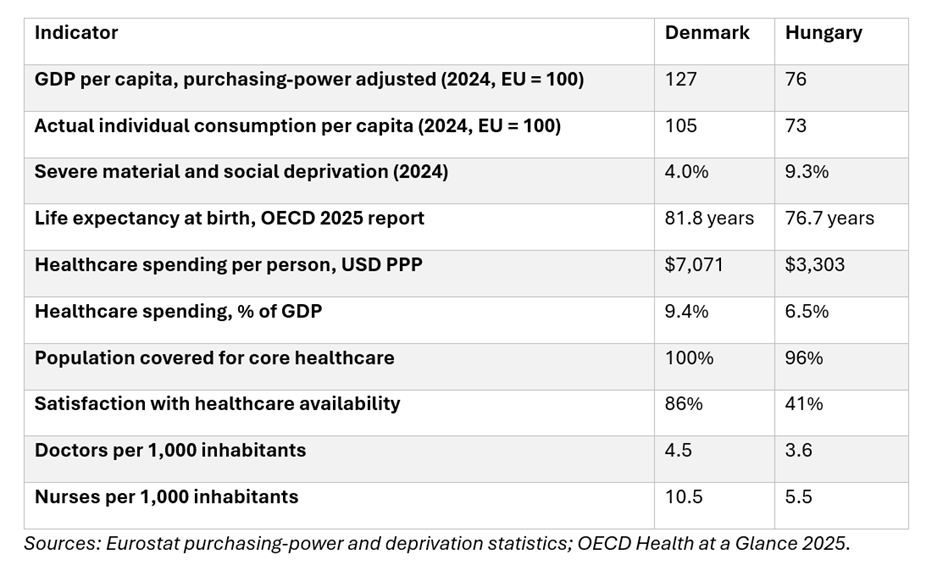
Here’s how Denmark and Hungary compare on key indicators of quality of life and wellbeing:
It’s Not Just What You Pay. It’s What You Get.
People don’t flee Denmark for Hungary because even though they pay more income taxes, their standard of living and quality of life is significantly better. But that’s not the end of the story. That’s because whether or not higher taxes translate into better results depends on how well the government can convert that money into a better life for all.
To see what I mean, consider the fact that Denmark, Ireland, and Iceland score worse on personal income tax burdens than France, which is dead last on the entire list. But people aren’t protesting in the streets in Dublin, Copenhagen, and Reykjavik as they have been in Paris.
That leads to point number two: When deciding on a place to live, focusing purely on tax rates isn’t a good idea. What you really want to know is how well that country can convert those taxes into quality of life.
This is the kind of detail that I bring to my consultancy service. So if you’re thinking about making a move abroad, let’s talk taxes… and quality of life.
Not signed up to Jeff’s Field Notes?
Sign up for FREE by entering your email in the box below and you’ll get his latest insights and analysis delivered direct to your inbox every day (you can unsubscribe at any time). Plus, when you sign up now, you’ll receive a FREE report and bonus video on how to get a second passport. Simply enter your email below to get started.