

And no one in Washington is prepared
The death of privilege is giving rise to an unconscionable burden.
That’s bad news for all of us who spend, save, and invest Uncle Sam’s money.
We’re going back some 80-plus years to start this dispatch—way back to 1944, when the ashes of the winners in a war-torn world gathered at a hotel in Bretton Woods, up in the White Mountains of New Hampshire, to shape the looming post-war financial world.
No European currency or economy was in a position to assume the role of global reserve. A half-decade of wanton killing and bombing had decimated them all. So, after much wrangling and infighting, the US dollar emerged as the world’s reserve currency.
It’s been all downhill since.
Amid the discord and dissension that characterized the Bretton Wood agreement, several voices saw the future better than others. Famed Brit economist John Maynard Keynes argued that pegging the dollar as the global reserve would force other countries to rely on American economic policy. Financial leaders of various other countries openly worried that by fixing their exchange rates to Sammy’s greenbacks, they’d be sacrificing their own monetary policy flexibility to the whims of a US Federal Reserve that really only had American interests at heart.
All of them were, of course, dead-on accurate.
But beggars, choosers…
War-ravaged nations desperately in need of money to rebuild their economies begrudgingly accepted the dollar standard because it was the only viable option—lack of enthusiasm be damned.
Which brings us to where we are today: A reserve-currency dollar on the brink of losing what a French finance minister in 1965 called America’s “exorbitant privilege.”
The loss of that privilege promises to be bad juju for American families.
I suspect most Americans don’t really think about the dollar as a global reserve currency, or the benefits that have accrued to America and to their own personal wealth. But consider what the dollars status as a reserve currency actually means in practical terms for the US and American families:
- Lower Borrowing Costs: Because the world needs dollars to facilitate global trade, the world is constantly buying dollars in the form of US Treasury debt. The demand allows Uncle Sam to borrow money from the entire world at interest rates that are much lower than they would be if all that forced demand didn’t exist. That flows through as much lower interest rates on mortgages, auto loans, and other forms of lending.
- Trade Deficits: The US imports goods from all over the world, and those imports are priced in dollars because the dollar is the grease for global trade. Aside from China, other countries don’t have that privilege. Which means America can run large trade deficits (importing way more than it exports) without facing a balance-of-payments crisis that would hit most other countries.
- Currency Stability: Because of ongoing global demand for the dollars necessary to fund global trade, the dollar is a stable currency that, in turn, provides domestic stability.
- Economic and Geopolitical Influence: The US has greater influence over global economic policies and financial markets. America can use the dollar as a bludgeon to manipulate other countries, otherwise those countries risk losing access to the dollars they and their local banks need.
- Capital Flows: A reserve-currency dollar means the US pulls in significant capital inflows from foreign investors. That money not only goes into the Treasury, which as noted above artificially lowers consumer interest rates, it pours into US stock markets, driving stock prices higher, which benefits American families saving for retirement.
As America’s exorbitant privilege fades, all that begins to go away. America becomes a much more expensive place to live, it sees sharply lower Wall Street returns, and worst of all the US government faces the extraordinary challenge of funding itself and repaying its monumental debts as demand for dollars shrivels.
And you might right be thinking, “OK, El Jefe—but you’re assuming the demand for dollars shrivels. Maybe you’re just being a Chicken Little, no?”
Fair point.
However, the dollar’s share of global currency reserves has already fallen over the last 25 years from 72% to 57%. The share of US Treasury securities held by foreign investors, meanwhile, has fallen from nearly 50% in 2014 to about 32% in early 2025, signaling a reduced appetite for dollar-denominated debt among official and private holders.
Moreover, I’m not the lone voice who’s worried about this.
Congressman Thomas Massie, a Kentucky Republican, recently posted this comment on Twitter/X:
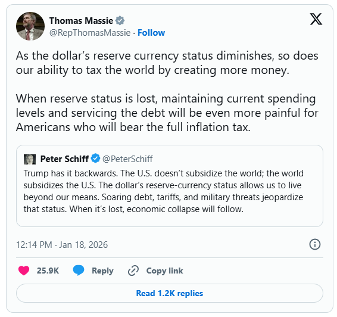
Truth is, reserve status is not long for this world. I suspect it’s all done and dusted by the end of the decade.
I’m not happy about that, of course.
The impacts will ravage the US economy like the earthquake/tsunami duo tag-teamed Fukushima, Japan 15 years ago.
Still, I share these thoughts because those who understand today’s dispatch will reflexively understand why they need to prepare for the inevitable: The world moving on from an 80-year-old agreement that once gave America an exorbitant privilege, and which has become America’s burden in an age of excessive debts.
Every chance you get, buy more gold. Buy more Swiss francs. And just sit on them.
They’ll see you through the death of privilege.
Not signed up to Jeff’s Field Notes?
Sign up for FREE by entering your email in the box below and you’ll get his latest insights and analysis delivered direct to your inbox every day (you can unsubscribe at any time). Plus, when you sign up now, you’ll receive a FREE report and bonus video on how to get a second passport. Simply enter your email below to get started.
